
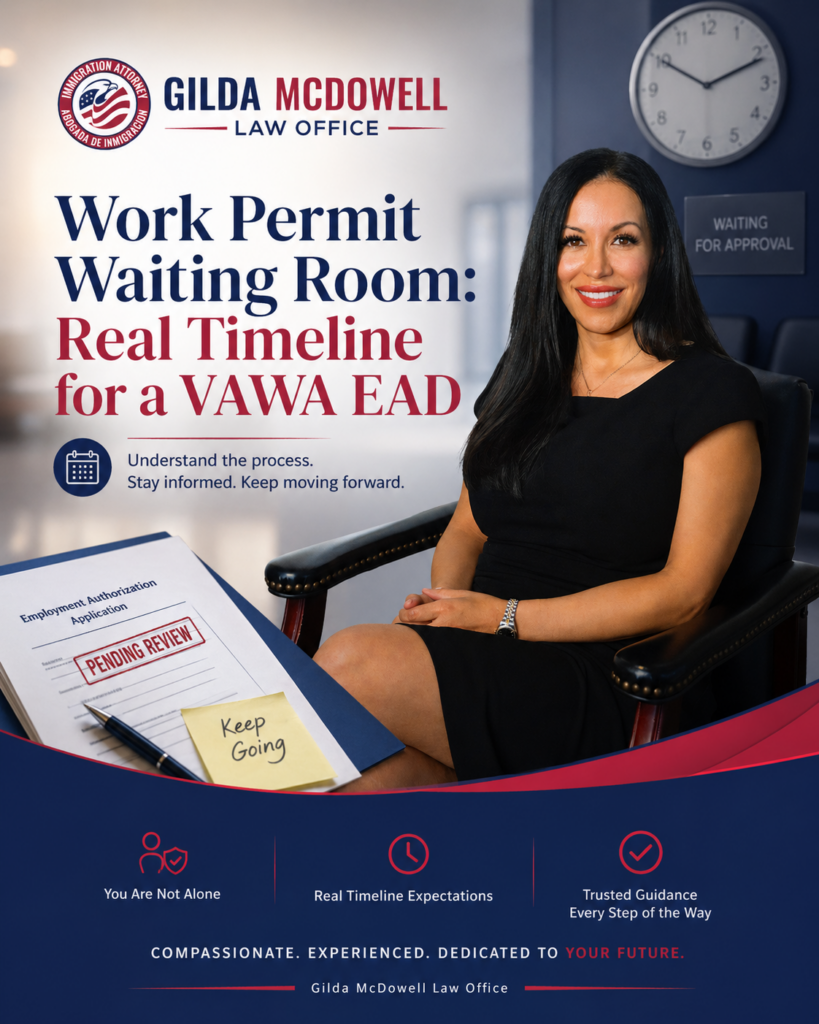
Introduction
For many survivors, the VAWA work permit processing time after filing I-360 feels less like a timeline and more like a pause button on life. After filing, everything can seem uncertain—whether you can work, whether your case is safe, and how long you will remain in financial and emotional limbo.
This waiting period is especially heavy for people trying to escape abuse. Many applicants are not just waiting for paperwork—they are waiting for freedom to earn money, leave unsafe living situations, and rebuild basic stability. The stress is often intensified by fear: fear that asking questions could alert an abuser, or that any mistake might harm their case.
What is rarely explained clearly is that this delay is not a single, linear process. USCIS separates different parts of your case, meaning progress can happen silently in the background while no updates appear on your file. This disconnect between “real progress” and “visible progress” is one of the most misunderstood aspects of VAWA-based work permits.
Understanding this distinction is critical. It shifts the experience from panic and confusion to informed patience. In this article, we will break down what is actually happening behind the scenes, why timelines vary, and what a realistic path forward looks like—so you can move from uncertainty to clarity.
The Core Problem
Why the Waiting Feels Worse Than the Timeline Itself
At the heart of the VAWA work permit processing time after filing I-360 is not just delay—it is uncertainty without explanation. Most applicants assume the problem is “processing speed,” but the deeper issue is the inability to see what is actually happening inside their case.
For many survivors, this creates a painful mental loop: “If nothing is moving, maybe something is wrong.” That assumption is understandable, especially for someone already living under fear, financial dependence, or emotional control. But it is often incorrect.
The Real Root Problem: Invisible Progress
The true issue is that VAWA-related work permits move through separate internal stages that are not visible to the applicant. One part of the case may be actively progressing while another appears frozen. This creates the illusion of inactivity even when USCIS systems are still working.
This is why many people misinterpret normal delays as denial, rejection, or risk. In reality, silence is often procedural—not personal.
How Fear Distorts Interpretation of Delay
For VAWA applicants, especially those in unsafe or controlling environments, waiting is not neutral. It is emotionally charged. Many are conditioned to expect consequences for “doing something wrong,” so every delay feels like a warning sign.
This leads to two common but harmful misunderstandings:
- Believing that no update means the case is failing
- Assuming faster cases are “normal” and slower cases are “problem cases”
Neither is necessarily true.
Expert Insight Most People Miss
A key overlooked dynamic is that USCIS processing does not operate on a linear “queue.” Instead, cases move through multiple background systems (identity checks, security screening, eligibility review) that do not update in real time. This means your file can be actively reviewed without producing any visible movement for weeks or even months.
Understanding this is critical. The waiting period is not just about time—it is about visibility. And
Hidden Dynamic or Overlooked Factor
The Invisible System Behind Your VAWA EAD Timeline
One of the least discussed realities behind the VAWA work permit processing time after filing I-360 is that your case is not processed as a single file moving neatly from start to finish. Instead, it is split across different internal systems that do not always communicate updates in real time.
This means your “waiting time” is often not a single delay—but multiple parallel processes happening at different speeds.
The Hidden Factor: Your Case Can Be Active Without Looking Active
A major overlooked dynamic in the VAWA EAD process is that USCIS may be running background checks, identity verification, and eligibility reviews while your case status appears unchanged for long periods.
For example:
- Biometrics data can be processed long after your appointment
- Security checks may continue independently in federal databases
- Work permit eligibility may be reviewed while the I-360 is still pending
From the outside, this looks like silence. But internally, it can be active processing.
This is why many applicants misjudge their situation and assume something is wrong when there is no update.
Why Timing Feels Unfair for Survivors
For VAWA applicants—especially those dealing with fear, financial dependence, or unsafe living conditions—this invisible processing creates emotional distress. The lack of visible progress can feel like being ignored or forgotten, even when the case is moving normally.
This misunderstanding often leads to unnecessary panic, repeated case checks, or fear-driven decisions that increase emotional strain.
Expert Insight Most Applicants Don’t Hear
A critical but rarely explained detail is that USCIS processing systems often separate adjudication from status updates. That means your case can be actively reviewed and still show “no change” online for weeks or months.
This disconnect is a known feature of immigration processing systems—not a sign of denial or error.
You can see how USCIS explains general processing timelines and variability in case movement here:
Why This Matters for Your Next Step
Understanding this hidden structure changes how you interpret the VAWA EAD processing timeline after I-360 filing. Instead of reading silence as danger, you begin to see it as fragmented processing—uneven, but still moving.
For someone trying to leave an abusive environment or regain independence, this clarity can reduce fear-driven decisions and help you stay grounded while your case progresses.
The Stakes and Consequences
When Misunderstanding the Timeline Becomes the Real Risk
Misreading the VAWA work permit processing time after filing I-360 is not just a matter of confusion—it can directly affect safety, stability, and long-term independence. For many applicants, the danger is not the delay itself, but the decisions made during the delay.
When someone expects fast movement but sees silence, fear often fills the gap. And fear-driven decisions can carry real consequences.
Financial Consequences: Forced Dependence or Survival Decisions
For many VAWA applicants, especially those in low-income or financially controlled households, the work permit is the difference between dependence and survival.
If the timeline is misunderstood, a person may:
- Stay longer in an unsafe home because they believe approval is “not coming soon”
- Miss opportunities for legal employment planning because they assume rejection is likely
- Rely fully on an abusive partner for financial survival due to uncertainty
Even a few extra months of delay without clarity can deepen financial vulnerability and limit future choices.
Emotional Consequences: Constant Fear and Decision Paralysis
When applicants misinterpret normal delays as denial, it often creates a cycle of emotional exhaustion:
- Repeatedly checking case status
- Fear that “something went wrong”
- Avoiding planning for the future
For survivors already living under emotional pressure, this uncertainty can feel like being trapped in a situation with no visible exit.
Legal and Procedural Consequences: Delayed Readiness
A misunderstanding of the VAWA work permit processing timeline after I-360 filing can also lead to missed readiness moments—such as not preparing documents, not tracking notices properly, or not understanding what stage the case is actually in.
While the case itself is still moving, the applicant may be mentally “paused,” which slows their ability to respond effectively when USCIS does act.
Long-Term Consequences: Delayed Independence
The most important impact is long-term: delayed independence.
Every month spent misreading the process can extend:
- Economic dependency
- Emotional stress
- Lack of mobility or freedom to leave unsafe environments
The system itself may be slow—but misunderstanding it makes the waiting feel longer, heavier, and more isolating than it actually is.
A Framework or Guidance Path
A Clear Way to Understand Your VAWA EAD Timeline Without Panic
When you are navigating the VAWA work permit processing time after filing I-360, the biggest challenge is not just waiting—it is not knowing how to interpret what is happening. A structured approach helps you avoid fear-based assumptions and focus on what actually matters at each stage.
Below is a simple, practical framework to guide your decisions and expectations.
Step 1: Confirm Your Filing Stage (Stability Checkpoint)
First, confirm that your I-360 and I-765 were properly received.
- Why it matters: Missing or incorrect filings can create avoidable delays
- What to avoid: Assuming “silence = problem” without confirming receipts
Step 2: Track Milestone Events, Not Daily Updates
Focus only on major events like:
- Receipt notices
- Biometrics appointment
- Requests for evidence (if any)
- Why it matters: Daily status checks create false anxiety
- What to avoid: Interpreting “no update” as rejection
Step 3: Understand Parallel Processing (Key Insight)
Your VAWA EAD processing timeline after I-360 filing does not move in a straight line. Different parts of your case move separately.
- Why it matters: Explains why progress is often invisible
- What to avoid: Comparing your timeline to others
Step 4: Identify Normal vs. Concerning Delay
- Normal: Weeks or months with no visible updates
- Concerning: Missing notices, incorrect addresses, or expired receipts
- Why it matters: Helps reduce unnecessary fear
- What to avoid: Self-diagnosing denial without evidence
Step 5: Prepare for Approval Before It Arrives
While waiting, organize:
- ID documents
- Work readiness materials
- Secure mailing address
- Why it matters: Approval often comes without warning
- What to avoid: Being unprepared when EAD is issued
Step 6: Use Trusted Information Sources Only
Rely on official immigration guidance to avoid misinformation during emotional stress.
- Why it matters: Reduces fear-based rumors and incorrect advice
- What to avoid: Unverified online claims or informal advice loops
Core Principle of This Framework
Progress is not always visible—but it is structured. When you understand the system, you stop reacting emotionally to silence and start responding strategically to facts.
This approach helps you stay grounded while your case moves through its natural stages.
A Strong Outcome Looks Like
What Life Looks Like When the Timeline Is Understood—and Works in Your Favor
A strong outcome in the VAWA work permit processing time after filing I-360 is not just about receiving a card. It is about what that card changes—your ability to move safely, earn independently, and make decisions without fear.
In the best-case scenario, the moment your EAD arrives:
- You already have a safe mailing address secured
- You are prepared to apply for jobs immediately
- You understand your next legal steps without confusion
- You are no longer financially tied to an unsafe person
This is what clarity creates: not speed, but readiness.
Strong Outcome vs. Weak Outcome
Strong Outcome (Prepared + Informed):
- Financial stability begins quickly after approval
- Clear understanding of the VAWA EAD processing timeline after I-360 filing
- Reduced emotional stress because expectations were realistic
- Ability to leave or distance from an abusive environment safely
- A sense of control over your future decisions
Weak Outcome (Confused + Reactive):
- Missed opportunities due to lack of preparation
- Continued dependence because approval came as a surprise
- Ongoing fear due to misunderstanding delays
- Delayed transition into stable work and independence
Why Timing and Preparation Matter More Than Speed
Many applicants believe success depends on how fast their case moves. In reality, success depends on how well they use the waiting time.
When you understand the VAWA work permit processing time after filing I-360, you stop waiting passively and start preparing actively. That shift reduces risk, protects your privacy, and allows you to act quickly when approval happens.
The Future You Are Working Toward
The real goal is not just legal status—it is stability.
It looks like:
- Having your own income
- Making decisions without fear of retaliation
- Living in a space where your safety is not dependent on someone else
For broader context on how immigration pathways support long-term stability and independence, see:
This is what a strong outcome delivers: not just permission to work, but the foundation to rebuild your life on your own terms.
FAQs
1. How long is the VAWA work permit processing time after filing I-360?
The VAWA work permit processing time after filing I-360 typically ranges from several months to over a year, depending on your case type and USCIS workload. Some applicants receive their EAD while the I-360 is still pending, while others wait longer. The key factor is not just time, but which stage your case is in. Delays without updates are often normal and do not mean something is wrong.
2. Can I get a work permit before my I-360 is approved?
Yes, in many cases you can receive a work permit before your I-360 is fully approved. This depends on how your application was filed and which eligibility category applies. The VAWA EAD processing timeline after I-360 filing is not strictly tied to final approval. This is one of the most misunderstood parts of the process.
3. Why is my VAWA work permit taking so long with no updates?
A lack of updates is common and does not usually mean a problem. USCIS often processes different parts of your case in separate systems that do not update in real time. This makes the VAWA work permit processing time after filing I-360 feel longer than it actually is. Your case may still be actively moving behind the scenes.
4. What causes delays in VAWA EAD processing?
Common causes include background checks, biometrics processing, and overall case backlogs. Each step can take time and may not show visible progress. The VAWA work permit timeline after I-360 submission is affected by multiple factors, not just one delay point. This is why timelines vary widely between applicants.
5. Can I work legally while waiting for my VAWA work permit?
No, you must wait until your EAD is approved before working legally. Starting work too early can create serious problems for your immigration case. Even if the VAWA work permit processing time after filing I-360 feels long, it is important to wait for official authorization. Planning ahead can help reduce financial stress during this period.
6. Does no update mean my VAWA case is denied?
No, silence does not mean denial. Many applicants experience long periods with no updates, even when their case is progressing normally. The VAWA EAD processing timeline after I-360 filing often includes invisible steps that are not reflected online. It is important not to assume the worst without clear evidence.
7. What should I do while waiting for my VAWA work permit?
Use this time to prepare for stability after approval. This includes securing a safe address, organizing documents, and thinking about job options. Understanding the VAWA work permit processing time after filing I-360 helps you shift from waiting passively to preparing actively. This reduces stress and helps you act quickly when approval comes.
8. Can my abuser affect my VAWA work permit process?
No, your abuser cannot cancel or control your VAWA application once it is filed. VAWA cases are confidential, and USCIS does not notify the abuser. However, fear of retaliation can still impact your decisions during the VAWA work permit timeline after I-360 filing. Understanding your protections can help reduce that fear.
9. What happens if my work permit is delayed too long?
If your case goes beyond normal processing times, you may be able to submit an inquiry. However, most delays fall within expected ranges. The VAWA work permit processing time after filing I-360 can feel long, but taking premature action without understanding your case stage can create confusion. Focus on verified milestones instead.
10. How can I avoid mistakes while waiting for my VAWA EAD?
The most important step is to avoid making decisions based on fear or assumptions. Do not rely on rumors or compare your case to others. Instead, understand how the VAWA EAD processing timeline after I-360 filing actually works and prepare accordingly. Clarity and patience are your strongest tools during this period.
Conclusion
Understanding the VAWA work permit processing time after filing I-360 is not just about knowing how long it takes—it is about knowing what the waiting actually means. The biggest challenge is not delay itself, but the uncertainty created by invisible progress, fragmented processing, and lack of clear updates.When this process is misunderstood, the consequences are real: prolonged financial dependence, emotional stress, and delayed independence. But when you understand how the system actually works, the waiting period becomes more manageable. You stop reacting to silence and start making grounded, informed decisions.The difference is clear. Staying in uncertainty leads to fear, hesitation, and missed opportunities. Moving forward with clarity allows you to prepare, protect yourself, and act with confidence when your moment comes.You are not just waiting—you are moving through a process that can lead to stability, safety, and independence.
If you are unsure where your case stands or how to interpret your timeline, speaking confidentially with a legal professional can help you avoid unnecessary risk and make clear, informed decisions about your next steps—safely and on your terms.