
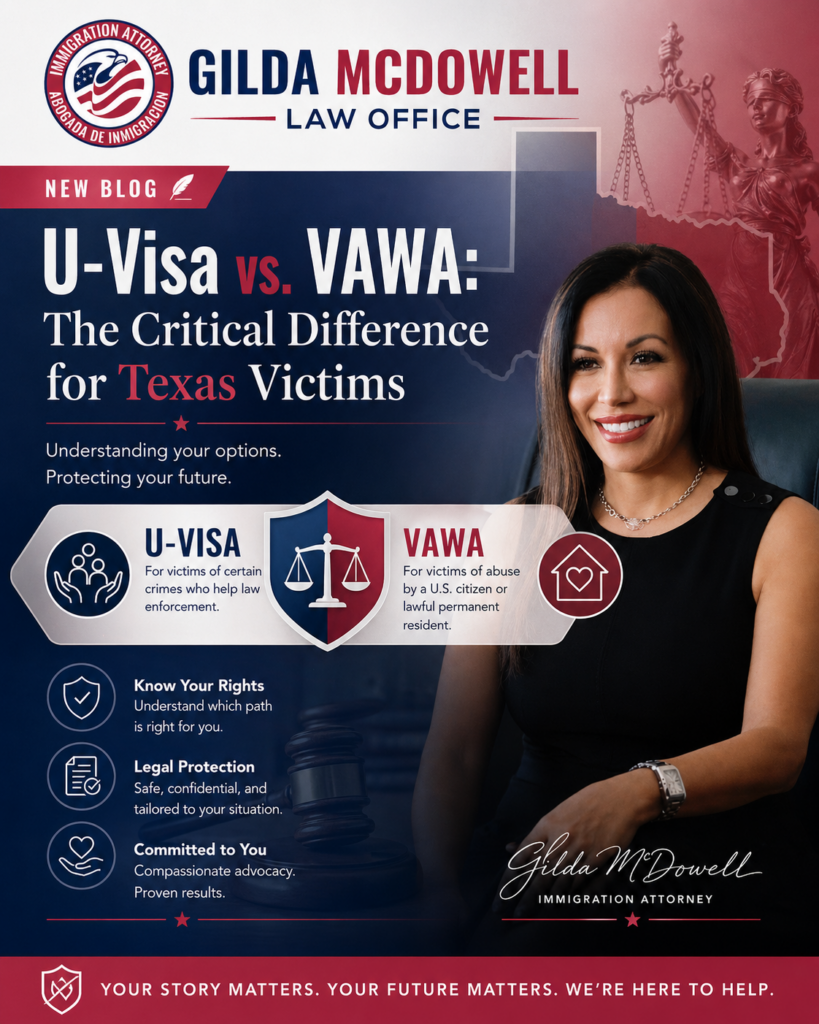
For many survivors in Texas, the decision to seek help is not just emotional—it is dangerous. Fear of retaliation, fear of being reported to immigration, and fear of losing financial survival often keep victims trapped in silence far longer than they should be.
Understanding the difference between U-visa and VAWA for domestic abuse victims is often the first real step toward breaking that silence. But for most people, the options feel confusing, overwhelming, and filled with risk—especially when the abuser has control over money, housing, or even threats involving immigration status.
The reality is that these two legal pathways are designed for very different situations, yet they are often misunderstood as interchangeable. That misunderstanding can delay protection, increase danger, and prevent survivors from taking action when they actually already qualify for help.
What is rarely explained clearly is this: one option is built around cooperation with law enforcement, while the other is designed to protect survivors even when speaking out is unsafe. That distinction can completely change a person’s future.
This article breaks down those differences in simple, practical language so you can understand what applies to your situation—without pressure, confusion, or legal jargon—so you can make a safer, more informed decision at the moment it matters most.
The Real Issue Is Not Choice — It Is Fear-Based Misunderstanding
At the surface, many survivors believe their problem is deciding between two immigration options. But the real issue runs much deeper: most people are trying to understand legal protection while still living inside fear, control, and emotional pressure.
This is why the Difference between U-visa and VAWA for domestic abuse victims often feels confusing. It is not just a legal question—it is a safety question. When someone is afraid of their partner, afraid of immigration authorities, and afraid of losing financial support, the brain naturally looks for the “safest possible guess,” not the most accurate legal answer.
Why Most Survivors Misinterpret Their Own Situation
A common blind spot is assuming that all immigration relief requires police involvement or visible reporting. Many victims quietly believe: “If I haven’t gone to the police, I have no case.” This is not true, but it is a belief shaped by fear, isolation, and misinformation.
This misunderstanding causes delay. And delay increases dependency on the abuser, which makes the situation even harder to escape.
The Hidden Pressure That Changes Every Decision
Most survivors are not making calm legal decisions. They are making survival-based decisions while being emotionally controlled, financially dependent, or threatened with deportation.
That pressure distorts judgment in three ways:
It makes safe options feel risky
It makes risky silence feel “safer”
It prevents asking for help early
Expert Insight Most People Overlook
One critical but rarely discussed reality is this:
VAWA and U-Visa are not just immigration categories—they are safety design systems.
VAWA exists specifically for situations where involving the abuser (or law enforcement) would increase danger. U-Visa exists for situations where cooperation with authorities is possible and safe.
The mistake most survivors make is trying to choose between them based on confusion, instead of first identifying their safety environment. The correct “starting point” is not paperwork—it is risk.
Understanding this shift in thinking is often what changes everything: it turns the decision from overwhelming uncertainty into a structured, survivable path forward.
The Timing Trap Most Survivors Are Never Told About
One of the least discussed realities in the Difference between U-visa and VAWA for domestic abuse victims is that timing often matters more than eligibility itself. Many survivors assume they must “wait until they are ready” or “wait until something official happens” before taking action. In practice, that delay can quietly affect the strength and safety of their case.
The Hidden System Rule: Evidence Is Created Over Time
Both U-Visa and VAWA cases depend heavily on documentation, but the way that documentation is formed is very different—and this is where most confusion happens.
With a U-Visa (U visa vs VAWA self-petition scenarios), the process often depends on interaction with law enforcement and certification from authorities. That means the opportunity to qualify can be influenced by whether a report is made and how early that step occurs.
With VAWA, survivors can often file without the abuser knowing, but they still need to build a timeline of evidence showing the relationship and abuse.
What is rarely explained is this: waiting does not pause risk, but it can weaken evidence opportunities.
Why Fear Delays Create Legal Consequences
For many victims, fear of immigration consequences or retaliation leads to silence. But silence has an unintended effect—it reduces the creation of external records that could later support a case.
This creates a difficult paradox:
Speaking up may feel unsafe in the moment
Staying silent may limit future legal options or documentation strength
Expert Insight Most Legal Guides Overlook
A key but under-discussed factor is that immigration relief systems are not just reactive—they are timeline-sensitive frameworks. Once certain events pass without documentation or reporting, it can become harder to reconstruct them later in a legally persuasive way.
This does not mean survivors are “out of options” if they wait. It means the strongest cases often come from early clarity about which path—VAWA confidentiality or U-Visa cooperation—matches their safety reality.
For official information on U-Visa protections and eligibility structure, see the U.S. Department of Homeland Security overview.
Understanding this timing dynamic can shift how survivors view their situation—from feeling stuck in uncertainty to recognizing that informed, early decisions can preserve both safety and future legal strength.
When Confusion Becomes Delay
For many survivors trying to understand the Difference between U-visa and VAWA for domestic abuse victims, the biggest risk is not making the “wrong” choice—it is not making any informed choice at all. Confusion often leads to delay, and delay quietly reshapes the entire situation in ways that are hard to reverse later.
Financial Consequences: Dependence Becomes Harder to Escape
Many victims in abusive relationships rely on their partner for housing, food, transportation, or even basic documentation. When action is delayed, this dependence often deepens.
For example:
A survivor may stay in the home longer because they believe they “need permission” or a police report first
Without legal clarity, they may avoid work opportunities or reporting abuse
Financial control by the abuser becomes stronger over time
This makes eventual separation not only emotionally difficult, but financially overwhelming.
Legal Consequences: Lost Opportunities for Stronger Cases
Misunderstanding U visa vs VAWA self-petition options can also affect how strong a future application becomes.
If a survivor delays:
Important events may go undocumented
Witnesses may become unavailable
Supporting evidence may become harder to reconstruct
Even when eligibility still exists, the case may become more complex or slower due to missing early records.
Emotional Consequences: Normalization of Fear
One of the most damaging effects is emotional normalization. Over time, victims may begin to accept fear, control, and isolation as “normal life.”
This leads to:
Increased anxiety and helplessness
Reduced confidence in seeking help
Belief that escape is no longer possible
The longer this continues, the harder it becomes to imagine a safe alternative.
Long-Term Consequences: Shrinking Options Over Time
From a long-term perspective, delay can quietly reduce flexibility. Survivors may lose the emotional energy, documentation clarity, or legal awareness needed to act when they finally feel ready.
In practical terms, the “future you” may face a harder version of the same problem—just with fewer options and more pressure.
Understanding these stakes is not about fear—it is about clarity. The earlier the situation is understood correctly, the more control a survivor has over what happens next.
A Simple Decision Framework: Choosing Between Protection Paths
When trying to understand the difference between U-visa and VAWA for domestic abuse victims, most survivors feel overwhelmed because they are thinking in uncertainty, not structure. The following framework is designed to bring clarity step by step—based on safety, not pressure.
Step 1: Start With Safety, Not Paperwork
Before thinking about forms or eligibility, ask one question:
“Is it safe for me to involve the abuser in any way?”
If the answer is no or uncertain, this immediately points toward a VAWA self-petition pathway (VAWA vs U visa comparison context) because it is confidential and does not require the abuser’s knowledge.
If it is safe to interact with authorities, then a U-Visa (U visa vs VAWA self-petition decision pathway) may become relevant.
Why this matters:
Safety determines strategy—not the other way around.
Step 2: Identify Your Evidence Reality
Next, evaluate what currently exists:
Do you have or can you obtain police involvement or official reports? → U-Visa may be possible
Do you primarily have personal evidence (messages, witnesses, photos, relationship proof)? → VAWA may still apply
What to avoid:
Do not assume “no police report = no options.” That is one of the most common misconceptions.
Step 3: Understand Confidentiality Risk
Ask:
Will reporting expose me to danger or retaliation?
Will my abuser find out?
If confidentiality is essential, VAWA is often designed for this exact situation.
Step 4: Build Before You Decide
Even before filing anything:
Start preserving evidence safely (messages, documents, timelines)
Avoid deleting communication history
Do not confront the abuser about immigration options
Expert Rule of Thumb
If safety is uncertain → prioritize confidentiality (VAWA)
If law enforcement involvement is already part of your situation → U-Visa may fit
For official guidance on victim-based immigration protections, see USA.gov.
This framework is not about forcing a decision—it is about removing confusion so survivors can move from fear-based thinking to structured, safer clarity.
What Success Actually Feels Like in Real Life
When survivors finally understand the difference between U-visa and VAWA for domestic abuse victims, the goal is not just paperwork approval—it is a complete shift in control, safety, and daily life stability. A strong outcome is defined by what changes in everyday reality, not just legal status.
Strong Outcome: Stability, Privacy, and Control Restored
In a strong outcome, the survivor is no longer making decisions under fear. Instead, they begin to regain structure in life:
Financial stability: The ability to work legally and gradually reduce dependence on the abusive partner
Privacy and safety: No need to expose themselves to the abuser or risk retaliation when seeking protection (especially through VAWA’s confidential pathway)
Clarity and control: Understanding whether their case aligns with a U-Visa vs VAWA self-petition strategy, and knowing what steps come next
Emotional relief: Reduced constant anxiety about deportation threats or being reported
Predictable future: A clearer understanding of long-term legal status possibilities
Weak Outcome: Delay, Confusion, and Ongoing Risk
Without clarity or timely action, the situation often looks very different:
Continued financial dependence on the abuser
Ongoing fear of seeking help due to immigration confusion
Loss of potential evidence or documentation over time
Emotional exhaustion from living in uncertainty
Feeling “stuck” with no visible exit path
In these cases, the problem is not lack of eligibility—it is lack of structured understanding at the right time.
Why Timing and Strategy Change Everything
The most important difference between strong and weak outcomes is not luck—it is timing and informed decision-making. Survivors who understand their options early can choose a path aligned with safety (whether U visa vs VAWA considerations or confidentiality needs), instead of reacting under pressure.
Early clarity allows:
Better evidence preservation
Lower emotional stress
More controlled decision-making
Safer transitions out of abusive environments
For broader global context on supporting survivors of domestic violence and access to protection systems, see UN Women.
A strong outcome is ultimately not just legal protection—it is the return of safety, independence, and the ability to plan life without fear guiding every decision
FAQs
The main difference is who the protection is designed for and how you qualify. A U-Visa is for victims of certain crimes who help law enforcement, while VAWA allows abused spouses or family members to apply on their own without the abuser knowing. The difference between U-visa and VAWA for domestic abuse victims often comes down to safety and privacy. One may require interaction with authorities, while the other is fully confidential.
A police report is usually important for a U-Visa because it helps prove you were a victim and cooperated with law enforcement. However, VAWA does not require a police report in the same way. Instead, it focuses on proving the abusive relationship through other types of evidence. Many survivors mistakenly delay action because they think a police report is always required.
In many cases, VAWA is considered safer because it can be filed without the abuser knowing. This is especially important when reporting abuse could lead to retaliation or immigration threats. The VAWA vs U visa comparison becomes critical in situations where safety and secrecy are top concerns. Choosing based on safety, not pressure, is essential.
In some situations, it may be possible to explore both options, but eligibility depends on your specific circumstances. The systems are different, and not every case qualifies for both pathways. What matters most is understanding which option aligns with your safety and evidence situation. A careful review usually determines the best strategy.
Misunderstanding the difference can lead to delays, lost evidence, or choosing a path that does not match your safety needs. For example, someone may avoid reporting abuse when they actually qualify for protection. Others may report too early without understanding the risks involved. The biggest danger is delay caused by confusion.
Waiting does not automatically remove eligibility, but it can make your case harder to prove. Evidence may become harder to collect, and memories or documents may fade over time. The U visa vs VAWA self-petition timing difference is important because early action often strengthens documentation. Delay usually increases stress and uncertainty.
No, financial independence is not required to qualify. In fact, many survivors applying under VAWA or U-Visa are financially dependent on their abuser. These programs are designed for people in vulnerable situations, not those who already have stability. Financial dependence is often part of the abuse dynamic, not a barrier to protection.
Yes, lack of formal police records does not automatically disqualify you. Many VAWA cases rely on personal testimony, communication records, or witness statements. The key is building a consistent picture of the relationship and harm. Many survivors underestimate what counts as valid evidence.
Fear is one of the biggest reasons survivors delay or avoid applying. It can make both options seem risky, even when one may actually be safer. The emotional pressure can distort decision-making and lead to inaction. Understanding the difference between the two options helps reduce that fear with clarity.
The first step is not paperwork—it is understanding your safety situation. Ask whether involving others (like police or immigration authorities) increases or reduces your risk. That answer often guides whether a U-Visa or VAWA approach is more appropriate. Clarity at this stage prevents costly mistakes later.
Conclusion
Understanding the Difference between U-visa and VAWA for domestic abuse victims is not just about immigration law—it is about recognizing what kind of protection fits your reality, your safety, and your level of risk. Many survivors stay stuck not because they lack options, but because fear, confusion, and misinformation make every option feel unsafe.
The hidden dynamic throughout this process is simple but powerful: timing, safety, and evidence all work together. Waiting too long can quietly weaken your ability to document your experience, while acting without clarity can increase emotional and safety risks. This is why understanding the difference between these two pathways is so important—it turns uncertainty into structure.
The stakes are real. Staying in uncertainty often means continued financial dependence, emotional stress, and ongoing exposure to control or threats. Moving forward with clarity, on the other hand, creates the possibility of stability, privacy, and long-term protection.
What changes everything is not speed—it is informed direction. Once you understand how U-Visa and VAWA work differently, you can begin to see your situation not as trapped, but as navigable.
If you are unsure which path fits your situation, the safest step is to speak with someone who can help you understand your options in a confidential and respectful way. A private conversation can help you avoid mistakes, reduce risk, and make a decision based on clarity—not fear.