
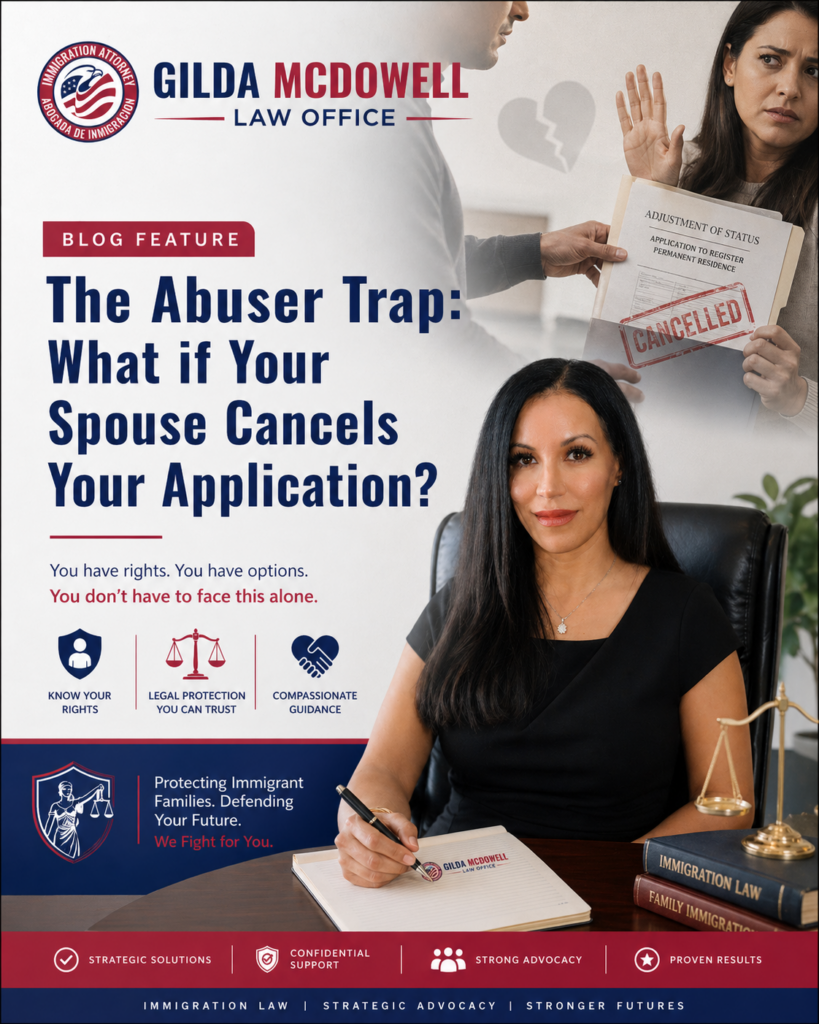
Introduction
If you are asking “What happens if my VAWA abuser cancels my green card application?”, you are likely already in a situation filled with fear, uncertainty, and pressure from someone who has controlled your life. For many VAWA and U-Visa applicants, this fear is not theoretical—it is immediate. The thought that an abusive spouse could interfere with your immigration process is often enough to stop people from seeking help at all.
Here is the reality that is often not explained clearly: in most cases, your immigration protection under VAWA or a U-Visa is not dependent on your abuser’s approval, cooperation, or continued support. Yet many survivors are told the opposite, or they assume the abuser still holds power over the process.
This misunderstanding creates silence, delay, and unnecessary suffering. Abusers often use threats like “I will cancel your papers” or “I will call immigration” to maintain control—even when they no longer have legal power to do so.
This article will break down what those threats actually mean, what can and cannot be canceled, and how immigration authorities really handle these situations. You will also learn the hidden dynamics that most general legal explanations overlook—especially how timing, evidence, and independent filings can completely change the outcome.
You are not alone in this fear, and you are not as powerless as the situation may feel.
The Core Problem
The Surface Fear vs. the Real Issue
At first glance, the question “What happens if my VAWA abuser cancels my green card application?” sounds like a legal worry about paperwork. But for most VAWA and U-Visa applicants, the real issue is not the application—it is control.
Many survivors believe their immigration case is still tied to their spouse’s permission, cooperation, or silence. This creates a powerful fear loop: if I speak up, they will stop my case; if I stay quiet, I stay trapped.
In reality, the deeper problem is misunderstanding who has legal power in the process versus who had personal power in the relationship.
Why This Misunderstanding Happens
Abusive partners often intentionally blur the line between legal authority and emotional control. Statements like “I will cancel your green card” or “I will withdraw your case” are used as psychological tools—not legal truths.
So when survivors search what happens if my VAWA abuser cancels my green card application, they are usually not just asking about immigration rules. They are trying to confirm whether the abuser still has a final “switch” to control their future.
This fear is reinforced by isolation, lack of trusted legal guidance, and confusion about immigration systems that feel complex and distant.
Expert Insight Most People Miss
A critical but rarely understood dynamic is this: in VAWA-based self-petitions, the abuser does not control the outcome once the petition is properly filed and accepted for review. The process is designed specifically to remove the abuser’s ability to interfere.
However, many applicants do not realize the importance of timing. Before a petition is properly filed or acknowledged, misinformation and threats can have a chilling effect, causing victims to delay action. That delay—not the abuser’s actual legal power—is often what creates the biggest risk.
The Real Core Problem
So the true issue is not whether an abuser can cancel your case. It is whether fear, misinformation, and emotional pressure are preventing you from taking independent legal steps at the right time.
Once that is understood, the entire situation shifts from confusion to clarity—and from control by fear to informed action.
Hidden Dynamic or Overlooked Factor
The Timing Trap Most Applicants Never See
One of the least discussed realities behind What happens if my VAWA abuser cancels my green card application? is that timing—not the abuser’s action—often determines whether fear becomes reality or is simply a threat with no effect.
Many applicants assume the immigration process is “on hold” until everything is perfect, especially when an abusive spouse is involved. But in practice, immigration protection under VAWA is designed to become independent at a specific point: once a self-petition is properly filed with USCIS.
Before that filing, an abuser’s threats can feel powerful because the survivor has not yet activated legal protection. After filing, however, the system shifts—control moves away from the abuser and into a federal review process that does not rely on their permission or continued involvement.
The Overlooked System Behavior
A critical but rarely explained factor is this: abusers cannot directly cancel a VAWA self-petition once it is in the system. However, they may still create confusion by making threats during the early stages, especially when survivors are gathering documents or waiting to file.
This creates a dangerous psychological gap. During this period, survivors often delay action out of fear that “starting the process too early” could make things worse. In reality, delay is what increases vulnerability—not the filing itself.
According to USCIS guidance on VAWA protections, the self-petition process is specifically structured to allow victims to apply without the abuser’s knowledge or consent, reinforcing independence from the abusive relationship:
Why This Matters for Your Situation
For many people searching what happens if my VAWA abuser cancels my green card application, the hidden risk is not cancellation—it is hesitation caused by misinformation.
Abusers often exploit this gap in understanding by timing their threats precisely when the survivor is considering legal action. This is not a legal advantage; it is a psychological tactic.
Once you understand this timing dynamic, the situation becomes clearer: the immigration system is not waiting for your abuser’s permission—it is waiting for your independent filing decision.
Key Insight
The real turning point is not when the abuser speaks—it is when you legally enter the process on your own terms.
The Stakes and Consequences
When Fear Controls Decisions Instead of Facts
When someone keeps asking what happens if my VAWA abuser cancels my green card application, the deeper risk is not the question itself—it is allowing fear-based assumptions to delay action or distort decision-making. In VAWA and U-Visa cases, hesitation often creates more harm than the abuser’s actual legal power.
For many survivors, especially those financially dependent on their spouse, this delay can quietly reshape their entire future.
Financial Consequences
If a survivor believes the abuser can “cancel” the case and decides not to file independently, they may remain stuck in financial dependence. This often means:
- Continuing to rely on the abuser for housing, food, or basic needs
- Avoiding employment opportunities due to lack of work authorization
- Losing months or even years of potential legal stability and income growth
For a low-income applicant, even a few months of delay can mean ongoing economic vulnerability that becomes harder to escape over time.
Legal Consequences
Misunderstanding what happens if my VAWA abuser cancels my green card application can lead to one major legal risk: not filing at all or filing too late.
If eligibility windows close or evidence becomes harder to gather over time, the case may become more difficult to prove. Additionally, survivors may miss opportunities to protect themselves early through properly filed petitions or interim immigration protections.
Emotional Consequences
Abusers often use immigration threats as psychological leverage. If those threats are believed without verification, survivors may experience:
- Ongoing fear and anxiety
- Isolation from supportive people or services
- Feeling “trapped” even when legal options exist
This emotional burden often becomes heavier than the legal issue itself.
Long-Term “Future-You” Consequences
The most overlooked impact is long-term delay. A year spent waiting out of fear can mean:
- Delayed independence from the abusive environment
- Postponed ability to work legally
- Reduced confidence in navigating future legal decisions
In contrast, understanding that an abuser generally cannot control a properly filed VAWA or U-Visa application changes the entire trajectory—from survival mode to planning mode.
Key Takeaway
The real danger is not cancellation—it is misunderstanding the system long enough to let fear make decisions for you.
A Framework or Guidance Path
The “Independent Protection” Decision Framework
If you are trying to understand what happens if my VAWA abuser cancels my green card application, the most important step is shifting from fear-based thinking to a clear, structured decision process. The truth is, your outcome depends less on what the abuser threatens and more on how early and correctly you take independent legal steps.
Use the framework below as a practical guide.
Step 1: Separate Threats From Legal Power
Ask yourself:
- Is this something the abuser is saying, or something the immigration system actually allows?
- Have I seen any official notice or written confirmation from USCIS?
Why it matters:
Abusers often use words like “cancel,” “stop,” or “withdraw,” but in VAWA and U-Visa cases, those statements usually do not match legal authority once a self-petition exists.
Step 2: Confirm Your Filing Status
Determine where you are in the process:
- Not yet filed
- Filed but awaiting confirmation
- Already under review (VAWA/U-Visa in process)
Why it matters:
Your risk level changes completely depending on timing. Many fears about what happens if my VAWA abuser cancels your green card application disappear once a petition is officially received.
Step 3: Protect Evidence Early
Secure and preserve:
- Identity documents
- Proof of abuse or qualifying crime
- Any immigration or relationship records
Why it matters:
Evidence becomes harder to retrieve later, especially in controlled or abusive environments.
Step 4: Avoid Emotional Delay Traps
Do NOT:
- Wait for the abuser to “calm down”
- Rely on their promises or threats
- Delay filing due to fear of retaliation
Why it matters:
Delay—not cancellation—is the most common reason survivors lose momentum or miss protection opportunities.
Step 5: Move From Fear to Structure
Instead of asking repeatedly what happens if my VAWA abuser cancels my green card application, shift to:
- What stage am I in?
- What action is available now?
- What step reduces my dependency on the abuser?
Authority Reference
For official information on protections available to abused spouses and independent immigration options, see:
DHS immigration options for victims of crime
Core Insight
Once you follow a structured process, the situation becomes less about fear of interference and more about building legal independence step by step.
A Strong Outcome Looks Like
When the Process Works the Way It’s Supposed To
To fully understand what happens if my VAWA abuser cancels my green card application, it helps to picture what a strong, well-managed outcome actually looks like. In successful VAWA or U-Visa cases, the defining factor is not the abuser’s behavior—it is the survivor’s ability to move forward independently with the correct legal steps at the right time.
In a strong outcome, the survivor is no longer asking whether the abuser can interfere. Instead, the focus shifts to stability, planning, and rebuilding life with legal protection in place.
Strong Outcome: Stability and Independence
In a positive scenario:
- The survivor files independently and the case proceeds without relying on the abuser
- Work authorization becomes possible, opening access to stable income
- Housing and basic needs are no longer controlled by the abuser
- Communication with authorities becomes structured and safe, not fearful
This is where clarity replaces confusion. The question what happens if my VAWA abuser cancels your green card application becomes irrelevant because the process no longer depends on the abuser’s input.
Weak Outcome: Delay and Continued Control
In contrast, a weak outcome usually comes from hesitation or misinformation:
- Filing is delayed due to fear of threats
- The survivor remains financially dependent on the abuser
- Emotional stress continues because the situation feels “on hold”
- Opportunities for legal protection are postponed or lost
Over time, this creates a cycle where uncertainty—not law—dictates daily life.
What Changes the Outcome
The difference between these two paths is surprisingly consistent: timing and independent action.
When survivors act early, secure their documentation, and rely on verified legal protections, they reduce exposure to manipulation and gain control over their future.
According to the U.S. Department of Homeland Security, immigration protections for crime victims are specifically designed to support independence from abusers and encourage reporting and self-protection:
The Future State
A strong outcome is not just legal approval—it is freedom from fear-based decision-making. It is waking up without worrying whether a threat can undo your future, and knowing your case stands on its own legal foundation.
In that state, what happens if my VAWA abuser cancels my green card application is no longer a source of anxiety—it becomes a misunderstanding you have already moved beyond.
FAQs
1. What happens if my VAWA abuser cancels my green card application after I file?
If you are asking what happens if my VAWA abuser cancels my green card application, the key point is that in most VAWA self-petitions, the abuser does not have the power to cancel your case once it is properly filed. The process is designed to protect you from exactly that type of control. Your case is reviewed independently by immigration authorities. However, delays before filing can still create confusion and fear.
2. Can my spouse really stop my VAWA or U-Visa case from going forward?
In most cases, a spouse cannot directly stop your VAWA case once it is accepted for review. Many survivors searching VAWA abuser cancel green card application are reacting to threats rather than legal reality. The system is built to prevent abusers from controlling outcomes. What matters most is whether you file correctly and on time.
3. What should I do if my abuser threatens to cancel my immigration papers?
If your abuser threatens to cancel your application, it is usually a form of control, not a legal action. These threats are designed to create fear and delay your decisions. The safest approach is to verify your case status and focus on independent filing steps. Do not rely on the abuser’s statements for legal information.
4. Will I lose my green card process if I leave my spouse?
Many people worry that leaving the spouse will affect their case, especially when they search what happens if my VAWA abuser cancels your green card application. In VAWA cases, leaving or separating is often part of the protection eligibility. The key factor is proving the qualifying relationship and abuse, not ongoing contact.
5. Can my abuser withdraw my immigration petition before approval?
Before certain filings are complete, abusers may attempt to interfere with paperwork. However, once a VAWA or U-Visa self-petition is properly filed, it is generally no longer dependent on the abuser’s approval. The main risk comes from delay, not from withdrawal power.
6. What is the biggest mistake people make when dealing with VAWA threats?
The most common mistake is believing threats like “I will cancel your papers” without verifying the legal truth. This often leads to hesitation or delayed filing. When people search VAWA abuser cancel green card application, they are often already in a fear-based delay cycle. Acting early with accurate information is critical.
7. How does timing affect my chances in a VAWA case?
Timing is extremely important. Filing too late can make evidence harder to gather and prolong your dependency on the abusive situation. Many applicants do not realize that early independent filing reduces the abuser’s ability to influence their decisions emotionally or practically.
8. What if I don’t have a police report—can my case still work?
Yes, many VAWA and U-Visa cases do not require a formal police report. This is important for survivors who fear authorities or never reported the abuse. The system recognizes that many victims stay silent due to fear or control. Evidence can come from multiple other sources.
9. Can financial dependence affect my immigration options?
Financial dependence does not prevent you from applying, but it can delay action. Many survivors searching what happens if my VAWA abuser cancels your green card application are also financially controlled. This is why early filing is important—it can eventually open pathways to work authorization and independence.
10. What is the safest first step if I am afraid of my spouse’s threats?
The safest first step is to separate fear from facts and understand your current eligibility. Abusers often exaggerate their control over immigration systems. Once you understand that control is limited, you can begin preparing documents and taking structured legal steps. The goal is to move from uncertainty to clarity.
Conclusion
When you step back from the fear and confusion, the real issue behind what happens if my VAWA abuser cancels my green card application becomes much clearer. In most cases, the abuser does not hold the legal power that their threats suggest. Instead, the real risk lies in misunderstanding the process, delaying action, or staying trapped in uncertainty long enough for opportunities to pass.
Across this article, one pattern stands out: abusers rely on fear, timing gaps, and misinformation to maintain control. But the immigration system for VAWA and U-Visa applicants is specifically designed to shift that control away from the abuser and toward independent legal protection.
The difference between staying stuck and moving forward is not strength or courage alone—it is clarity plus timely action. When you understand your actual rights and the limits of an abuser’s influence, the situation changes from unpredictable to structured.
Staying in uncertainty keeps you exposed to emotional pressure, financial dependence, and delayed stability. Moving forward with informed steps creates the possibility of work authorization, legal independence, and long-term safety.
If you are still asking yourself what happens if my VAWA abuser cancels your green card application, that question itself is a signal that you deserve clear, confidential guidance tailored to your situation.
If you are in this position, consider reaching out for a private, secure conversation where your options can be reviewed without pressure. Speaking with the right guidance early can help you avoid delays, reduce risk, and make informed decisions with confidence and protection in mind.