
Introduction
For many U.S. citizen spouses living in places like Texas suburbs—raising children, working steady jobs, and trying to hold a family together—immigration is not an abstract legal issue. It is a daily source of anxiety. The biggest fear is simple: separation.That is why the question of howto prove extreme hardship for I-601A waiver without medical has become so important. Many families mistakenly believe they need a serious illness, hospital records, or a doctor’s letter to even qualify. When they do not have that, they assume their case is weak and delay taking action—sometimes for years.In reality, extreme hardship is much broader and far more nuanced than most people realize. It is not limited to medical emergencies. It includes the emotional impact on children, financial dependence between spouses, the instability of living apart, and even the uncertainty of consular processing in places like Juarez. These factors, when properly understood, often carry more weight than medical evidence alone.What is rarely discussed is this: many strong waiver cases are built not on dramatic situations, but on the combined pressure of everyday life being torn apart. That cumulative reality is exactly what immigration officers are trained to evaluate.This article will break down how that evaluation actually works, what most applicants misunderstand, and how families can build a strong, structured case even without a medical letter.
The Core Problem
The Real Issue Is Not “Lack of Medical Evidence”
At first glance, most people searching how to prove extreme hardship for I-601A waiver without medical insurance believe their problem is missing documentation. They think, “If we had a doctor’s letter, our case would be strong.”But this is a misunderstanding of how extreme hardship is actually evaluated.The real issue is not what evidence you don’t have. The real issue is that most families do not know how to translate their everyday life into legally meaningful hardship.
The Hidden Blind Spot: Everyday Struggles Don’t Feel “Legal Enough”
For U.S. citizen spouses in stable but emotionally strained households, life feels normal on the surface:
- A steady job in healthcare or education
- Children attending school in suburban Texas
- A marriage holding everything together under quiet stress
Because nothing looks “dramatic,” they assume nothing qualifies.
This creates a dangerous blind spot: they underestimate their own hardship.
They fail to recognize that immigration law is not looking for extreme medical crisis alone—it is evaluating what happens when a family structure is disrupted entirely.
How the Misdiagnosis Happens
Most applicants misread the system in three ways:
- They equate “extreme” with medical emergencies only
- They assume emotional or financial strain is “not enough”
- They wait for a perfect situation instead of building a complete one
This leads to hesitation, delay, and missed filing opportunities.
Expert Insight Most People Miss
A strong extreme hardship waiver without medical evidence is not built on one powerful factor—it is built on layered normalcy disruption.
In other words, immigration officers are often more influenced by the combined weight of:
- children’s emotional instability
- financial dependence between spouses
- inability to realistically live apart
- long-term uncertainty of consular processing
Individually, these may seem “moderate.” Together, they form a legally compelling picture of extreme hardship.
Core Reality
The true problem is not evidence shortage—it is translation failure. Families experience real hardship every day, but they do not know how to frame it in a way that matches how immigration law evaluates impact.
Until that gap is understood, most people will continue to underestimate their own case strength.
Hidden Dynamic or Overlooked Factor
The Timing Trap Most Families Never Recognize
One of the least discussed realities in the I-601A process is that timing often matters more than the type of evidence itself. Families focusing on how to prove extreme hardship for I-601A waiver without medical insurance usually assume the key challenge is collecting stronger documents. In reality, the bigger issue is when and how that hardship is presented to immigration authorities.
For many mixed-status families, the emotional pressure builds slowly—but the legal process does not wait for emotional readiness. Once the waiver strategy moves forward, USCIS evaluates hardship based on a structured “snapshot” of the family’s situation at the time of filing and foreseeable consequences of separation.
The Overlooked System Reality: It’s About “Foreseeable Separation,” Not Current Crisis
A major misconception is that hardship must already be fully visible or severe. In truth, officers are assessing what will predictably happen if the undocumented spouse is required to leave for consular processing in Juarez.
This is where many families underestimate their case.
They think:
- “We are managing fine right now, so maybe it’s not strong enough.”
But the legal lens asks:
- “What will this family realistically experience if separation becomes unavoidable?”
That difference is critical—and often misunderstood.
Why the Consular Processing Fear Is Legally Relevant
For AVATAR families, the fear of sending a spouse to Juarez is not just emotional—it is structurally relevant to hardship evaluation. The uncertainty of re-entry, combined with prolonged separation risk, is exactly what the waiver is designed to assess.
According to U.S. Citizenship and Immigration Services, the extreme hardship standard considers the totality of circumstances and how separation would impact qualifying relatives—not just isolated events or documents.
Expert Insight Most Applicants Miss
A strong case is not built by reacting after hardship becomes obvious—it is built by documenting foreseeable disruption before separation occurs. Many weak applications fail not because hardship is absent, but because the narrative is assembled too late, without demonstrating how multiple pressures would unfold over time.
Core Dynamic
The hidden factor is this: immigration officers are not only reviewing what is happening now—they are evaluating the logical trajectory of a family under forced separation. Families who understand this timing dynamic can structure far more persuasive cases, even without medical evidence.
The Stakes and Consequences
When Misunderstanding “Extreme Hardship” Becomes a Family Crisis
For many U.S. citizen spouses, the danger is not that they ignore the immigration process—it is that they move forward with the wrong understanding of how to prove extreme hardship for I-601A waiver without medical evidence. This misunderstanding can quietly turn into one of the most expensive and emotionally damaging mistakes a family can make.
Financial Consequences: One Income, Double Pressure
In a typical household in places like Plano or Katy, the undocumented spouse is often contributing through work, caregiving, or both. If they are forced into consular processing and separation occurs, the U.S. citizen spouse suddenly carries:
- Full household expenses on a single income
- Childcare costs that may require paid support
- Legal and travel expenses tied to ongoing immigration steps
What looked like a “manageable case” can quickly become a long-term financial strain that destabilizes the entire household.
Emotional Consequences: Silent but Deep Disruption
Children are often the most affected. Even if they continue school and daily routines, the emotional gap of a separated parent creates long-term instability.
For the spouse, the emotional burden includes:
- Constant uncertainty about reunification
- Fear of denial after consular processing in Juarez
- Ongoing stress that affects work performance and family life
This is not a temporary stress—it becomes a sustained emotional load that reshapes daily functioning.
Legal Consequences: Irreversible Process Risks
A poorly prepared extreme hardship waiver can lead to:
- Denial of the I-601A application
- Forced departure for consular processing without protection
- Increased exposure to long-term inadmissibility risks if errors occur
Once the process moves forward incorrectly, reversing it becomes significantly harder and more complex.
Long-Term Consequences: The “Delayed Life” Effect
Perhaps the most overlooked outcome is time loss. Families often spend years in uncertainty—waiting, reapplying, or trying to fix a weak initial case. During this time:
- Children grow up in fragmented households
- Career opportunities are delayed or limited
- Family plans remain permanently on hold
A misunderstanding of extreme hardship waiver requirements without medical evidence does not just affect paperwork—it reshapes years of a family’s life trajectory.
Core Reality
The stakes are not theoretical. They are immediate, compounding, and deeply personal. Every delay or misstep increases the likelihood that separation becomes longer, harder, and more financially and emotionally draining than families initially imagine.
A Framework or Guidance Path
When families try to understand how to prove extreme hardship for I-601A waiver without medical evidence, the biggest challenge is not effort—it is structure. Without a clear system, even strong facts feel disorganized and less convincing.
This framework is designed to help U.S. citizen spouses evaluate their case logically, reduce uncertainty, and avoid missing key elements that strengthen approval chances.C — Collect All Real-Life Hardship Factors (Not Just One Type)
Start by listing everything that changes if your spouse is forced into consular processing:
- Financial dependence and shared income structure
- Childcare and parenting responsibilities
- Emotional impact of separation
- Living situation disruption
Why it matters: USCIS evaluates the combined effect, not isolated issues.
L — Layer the Evidence into Categories
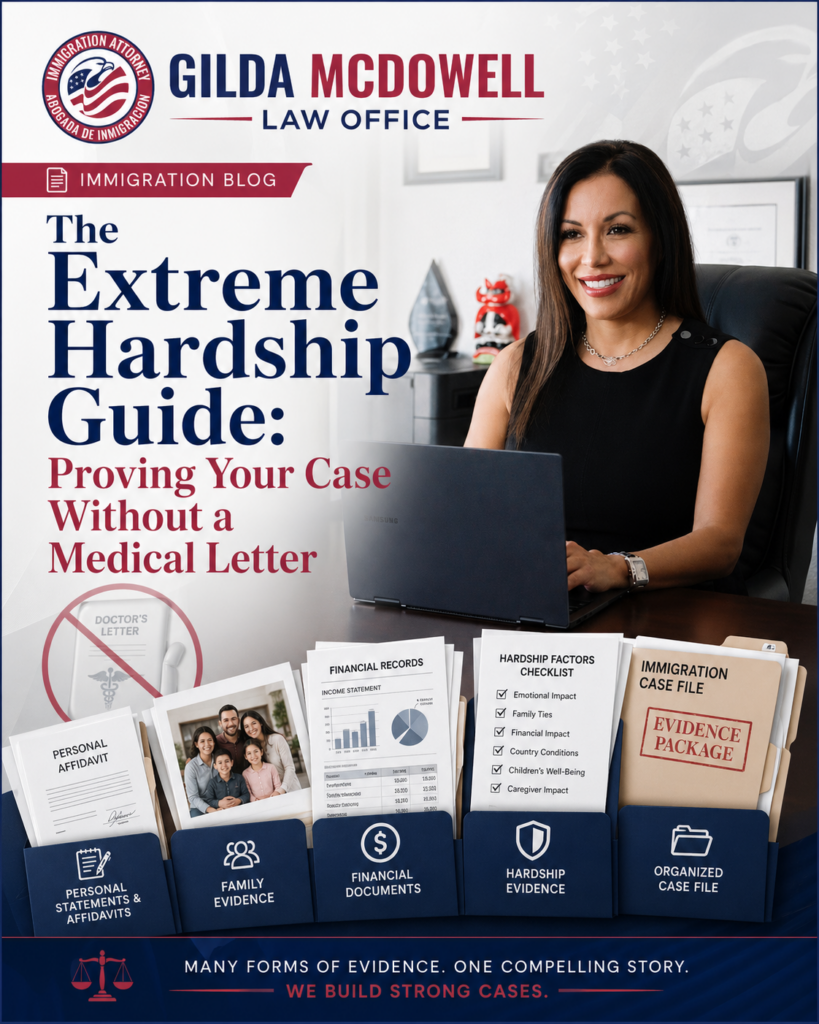
Instead of random documents, organize evidence into:
- Financial records (bills, income, expenses)
- Family impact (school records, parenting roles)
- Emotional support (affidavits, personal statements)
- Future risk (relocation difficulty, country conditions)
Why it matters: A structured presentation is easier for officers to assess and more persuasive.
A — Analyze “Foreseeable Separation” Impact
Ask: What realistically happens if my spouse goes to Juarez for consular processing?
Do not focus only on current stability—focus on future disruption.
This is critical in extreme hardship waiver cases without medical documentation, where predictive impact becomes central.
R — Reduce Weaknesses Before Filing
Avoid:
- Relying only on emotional statements
- Assuming financial hardship alone is enough
- Submitting unorganized or repetitive evidence
Instead, strengthen gaps before submission to avoid avoidable delays or denial.
I — Integrate a Clear Narrative
All evidence should tell one story:
“Here is how our family functions → here is what breaks if we separate → here is why it is unsustainable.”
T — Test for Consistency
Check:
- Does every claim have supporting evidence?
- Does the hardship build logically over time?
- Would an outsider clearly understand the impact?
Y — Yield a Decision-Ready Case File
A strong case is not just information—it is clarity. The goal is a file that USCIS can understand without interpretation gaps.
Authority Reference
For official guidance on how hardship is evaluated under immigration law, see U.S. Citizenship and Immigration Services (USCIS).
Core Insight
A successful strategy for how to prove extreme hardship for I-601A waiver without medical evidence is not about having dramatic proof—it is about building a structured, logical, and complete picture of family disruption.
A Strong Outcome Looks Like
For many U.S. citizen spouses, the goal is not just to “file paperwork”—it is to protect the family from uncertainty, financial strain, and emotional disruption. A strong outcome in an extreme hardship waiver case is not abstract. It is a very specific future where the family regains stability and control.
When how to prove extreme hardship for I-601A waiver without medical evidence is properly understood and applied, the result is a case that clearly shows USCIS why separation would cause serious, layered disruption—even without a medical letter.
Strong Outcome: Stability, Predictability, and Controlled Process
In a strong case scenario:
- The waiver is approved before consular processing begins
- The spouse attends the interview in Juarez with confidence, not fear
- The family has already planned for timelines, outcomes, and next steps
- Financial planning is intact because separation risk is minimized
- Children maintain emotional and educational stability
There is clarity at every stage. Instead of uncertainty, the family moves through a structured immigration process with reduced fear and better predictability.
Weak Outcome: Reactive Decisions and Long-Term Uncertainty
In contrast, a weak or poorly structured case often leads to:
- Denial of the I-601A waiver due to incomplete hardship presentation
- Forced consular processing without proper preparation
- Extended separation with no clear timeline for reunification
- Ongoing financial pressure on a single-income household
- Emotional strain that disrupts family stability for years
This outcome is not just stressful—it is unpredictable and prolongedWhy Preparation and Timing Change Everything
The difference between these two outcomes is rarely luck. It is structure and timing.
Families who properly understand extreme hardship waiver requirements without medical documentation tend to:
- Build layered evidence early
- Organize hardship logically instead of emotionally
- Align their documentation with how USCIS evaluates impact
This reduces delays and increases clarity in decision-making.
Future State: A Family Without Legal Uncertainty
In the best-case scenario, the family reaches a point where:
- Immigration is no longer a daily source of fear
- Financial planning is stable again
- Emotional energy is redirected toward children, work, and long-term goals
- There is no looming risk of sudden separation
This is the real objective behind a strong waiver strategy: not just approval, but long-term family stability and predictability.
Authority Reference
For official information on waiver processes and immigration eligibility, see the U.S. Department of Homeland Security overview of immigration services
FAQs
1. How to prove extreme hardship for I-601A waiver without medical evidence?
To prove extreme hardship for I-601A waiver without medical documentation, you must show the combined impact of financial, emotional, family, and practical life disruption. USCIS does not require a medical letter for a strong case. Instead, they evaluate how separation would realistically affect daily life, children, and long-term stability. Strong cases rely on layered evidence, not a single document.
2. What qualifies as extreme hardship for I-601A waiver if there is no illness involved?
Extreme hardship without illness can include financial dependency, childcare disruption, emotional distress, and inability to maintain a stable family structure. The key is showing that separation creates long-term instability, not just temporary inconvenience. Many families underestimate how powerful non-medical hardship factors can be when properly documented and explained.
3. Can I still qualify for an extreme hardship waiver without a doctor’s letter?
Yes, a doctor’s letter is not required to qualify for an extreme hardship waiver. Many strong cases are approved based on financial records, school documentation, personal statements, and evidence of family dependence. The focus is on overall impact, not medical conditions. The key is presenting a complete picture of hardship.
4. What is the biggest mistake people make when proving extreme hardship for I-601A waiver without medical proof?
The most common mistake is assuming that only severe illness qualifies as extreme hardship. This causes many families to delay filing or submit incomplete cases. Another major mistake is submitting emotional claims without supporting evidence. USCIS expects structured, consistent documentation that shows real-life consequences of separation.
5. How does financial hardship support an I-601A waiver case?
Financial hardship plays a major role when proving extreme hardship for I-601A waiver without medical evidence. If one spouse contributes to household income, childcare, or essential expenses, separation can create significant instability. USCIS considers whether the U.S. citizen spouse can realistically maintain financial stability alone. Documentation of income, expenses, and dependency strengthens the case.
6. Does having children make an extreme hardship waiver stronger?
Yes, children often strengthen an extreme hardship waiver because they add emotional, educational, and developmental factors to the case. Separation can disrupt schooling, emotional stability, and daily caregiving routines. These effects are considered highly relevant when evaluating long-term hardship. Proper documentation of parenting roles and school impact is important.
7. What happens if I underestimate my extreme hardship case?
Underestimating your case can lead to denial of the waiver or unnecessary delays in the immigration process. Families may then face consular processing without proper preparation, increasing emotional and financial stress. In some cases, this results in long-term separation. Proper evaluation before filing is critical.
8. How long does it take to prepare a strong extreme hardship waiver case?
Preparation time varies depending on documentation and case complexity. A strong case typically requires time to gather financial records, personal statements, and supporting evidence from multiple areas of life. Rushing the process often leads to gaps in the application. A structured approach improves clarity and approval potential.
9. Can emotional hardship alone support an I-601A waiver?
Emotional hardship alone is usually not enough, but it becomes powerful when combined with other factors like financial dependence and family disruption. USCIS evaluates the total impact of separation, not one isolated issue. Emotional evidence should be supported by real-life documentation to be effective.
10. What should I focus on when learning how to prove extreme hardship for I-601A waiver without medical evidence
The most important focus is building a complete picture of how separation affects your entire household. This includes finances, children, emotional well-being, and long-term family stability. Instead of looking for one “perfect” piece of evidence, focus on showing cumulative hardship. A structured and consistent narrative is what creates strong cases.
Conclusion
Understanding how to prove extreme hardship for I-601A waiver without medical evidence ultimately comes down to one core realization: strong cases are not defined by a single document, but by a complete and well-structured picture of how separation would disrupt a family’s real life.Many U.S. citizen spouses begin this process believing they are missing something essential—like a medical letter—when in reality, the stronger issue is often how their everyday responsibilities, emotional bonds, and financial dependence are presented and connected. Once the hidden dynamics are understood, the process becomes less about guesswork and more about strategy.The stakes are significant. Staying in uncertainty often leads to delayed decisions, missed opportunities, and increased risk of family separation during consular processing. In contrast, moving forward with clarity allows families to prepare properly, reduce avoidable stress, and build a case that reflects their true circumstances in a structured way.For families living with this pressure day-to-day, the difference between delay and preparation is not just legal—it is deeply personal and long-term.If you are unsure whether your situation meets the standard or how to properly structure your hardship evidence, it is important to get clarity before making irreversible decisions about consular processing or waiver filing. A confidential conversation can help you understand your options, identify risks early, and move forward with a strategy that protects your family’s future with greater confidence and control.