
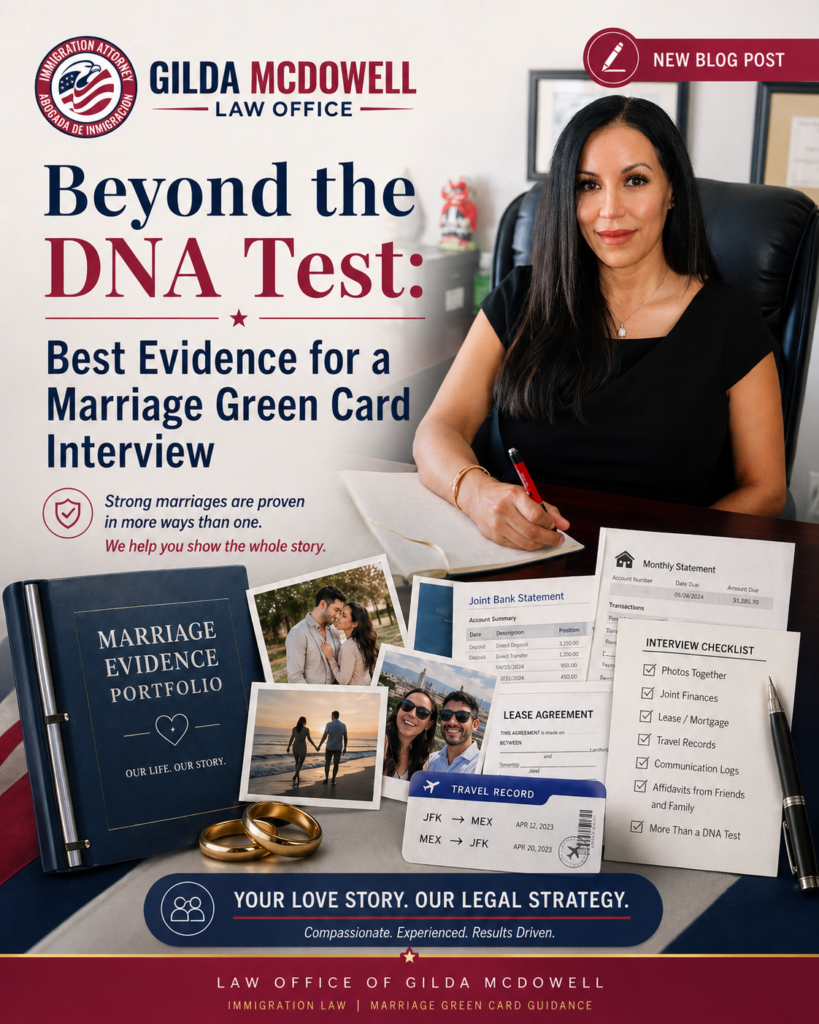
Introduction
For many U.S. citizen spouses, the green card process doesn’t feel like paperwork—it feels like a risk. Especially when consular processing means your husband or wife may have to leave the country for an interview in Ciudad Juárez, with no absolute guarantee they’ll be allowed back.
That fear changes everything.
Most couples assume that if their relationship is real—and especially if they have children together—approval should be straightforward. They focus on obvious proof: a marriage certificate, photos, maybe even a DNA test. But here’s what’s rarely explained clearly: that’s not what immigration officers are actually deciding.
The best evidence for a bona fide marriage green card interview is not about proving your relationship exists. It’s about proving your life together is real, consistent, and credible over time.
This is where many families unknowingly put themselves at risk.
Officers are trained to look beyond documents and identify patterns—how your finances, living situation, and daily routines align. Weak or misaligned evidence doesn’t just delay a case. It can raise doubts that follow you into the interview, especially in high-scrutiny locations like Juárez.
If you’re preparing for this process, what you do now directly impacts whether your family stays together—or faces months (or years) of separation.
This guide will show you what actually matters, what’s often overlooked, and how to prepare with clarity instead of fear.
The Core Problem
The Real Issue Behind “Best Evidence for a Bona Fide Marriage Green Card Interview”
At first glance, most couples believe the challenge is simple: collect enough proof and the case will be approved. But the real problem is not the quantity of documents—it is the inability to clearly demonstrate a lived, continuous marriage that makes sense to an outside reviewer.
This is where many U.S. citizen spouses misjudge the situation.
When people search for the best evidence for a bona fide marriage green card interview, they often assume there is a fixed checklist that guarantees success. In reality, officers are not ticking boxes—they are evaluating whether your relationship forms a believable life story from start to present.
Why Couples Misdiagnose the Problem
Most applicants focus on isolated proof: photos, wedding certificates, travel receipts. But these pieces, on their own, do not answer the real question being asked at the interview: Do these two people genuinely share a life together in a consistent, believable way?
This misunderstanding creates a dangerous gap. Couples may feel prepared because they have “enough documents,” while their case still lacks coherence when viewed as a whole.
The Hidden Dynamic Most People Miss
One of the most overlooked realities is this: immigration officers are trained to detect consistency gaps, not just fraud.
Even genuine couples can face problems if their evidence shows fragmentation—for example:
- Financial records that don’t align with living arrangements
- Timelines that feel incomplete or rushed
- Communication or lifestyle details that don’t match across documents and interviews
This is why even real marriages sometimes face intense questioning.
The issue is not whether the relationship exists—it is whether it reads as stable and logically consistent to someone reviewing it under pressure and strict guidelines.
For many families, especially those already worried about consular processing in places like Ciudad Juárez, this creates anxiety. They feel they must “prove love,” when in reality, they must present a structured, believable life pattern.
Understanding this shift—from proof of emotion to proof of structure—is the first step toward building a stronger case.
Hidden Dynamic or Overlooked Factor
The Timing Problem Most Couples Never Think About
One of the least discussed realities in immigration cases is that timing matters just as much as the evidence itself. When people search for the best evidence for a bona fide marriage green card interview, they usually focus on what to submit—but not when it was created.
Immigration officers don’t just review your documents as static proof. They evaluate how your relationship developed over time. Evidence that looks “suddenly assembled” close to the interview can unintentionally raise questions, even if the marriage is completely real.
Why “Last-Minute Evidence” Can Weaken Strong Cases
A common mistake is strengthening a file only after receiving interview notice—opening joint accounts, adding a spouse to insurance, or creating shared financial ties shortly before consular processing.
To the applicant, this feels responsible. To an officer, it can appear reactive rather than natural.
This is especially important for families preparing for interviews in high-scrutiny locations like Ciudad Juárez, where officers are trained to carefully evaluate consistency and relationship history under the lens of fraud prevention protocols.
The key issue is not the action itself—it is whether the evidence reflects a long-standing pattern or a recent adjustment under pressure.
The Hidden System Behavior: “Consistency Over Time” Is Weighted Heavily
According to U.S. Citizenship and Immigration Services guidance on marriage-based petitions, officers are instructed to assess whether the relationship shows a sustained shared life, not isolated milestones.
What this means in practice is simple but often missed:
- A marriage with gradual financial and household integration is seen as more credible
- A marriage with sudden “organized” documentation just before interview may trigger deeper questioning
This Matters Directly for U.S. Citizen Spouses
For the AVATAR family—often living in places like suburban Texas with children and stable routines—the fear is separation during consular processing. But the hidden risk is not just the interview itself; it’s how recently constructed evidence patterns may be interpreted under pressure.
Understanding this dynamic allows couples to shift from “preparing documents” to building a timeline that feels naturally lived, not assembled.
This subtle difference often determines how smoothly the interview experience goes.
The Stakes and Consequences
When “Small Gaps” Turn Into Serious Delays
For many families preparing for a marriage-based interview, it feels like missing or weak evidence is a minor issue that can be “explained later.” But in reality, misunderstandings around the best evidence for a bona fide marriage green card interview can lead to consequences that affect the entire family structure—not just the application.
A case that looks “incomplete” to an officer doesn’t usually end immediately in approval or denial. It often moves into delay, deeper scrutiny, or requests for additional proof that stretch the process for months.
Financial Pressure: The Hidden Cost of Delay
For a typical U.S. citizen spouse household earning $50k–$85k, delays can quickly become financially stressful. If a spouse is stuck abroad during consular processing:
- Dual household expenses increase
- Travel costs for visits or legal follow-ups rise
- Work stability may be disrupted due to emotional strain and time off
What begins as “just more documentation” can quietly turn into a prolonged financial burden.
Legal Risk: When Weak Evidence Triggers Extra Scrutiny
If officers are not convinced by the initial presentation of evidence for green card marriage interview preparation, cases can be sent into extended review or returned for additional documentation. In some situations, this can also raise concerns about credibility that are difficult to reverse later in the process.
The risk is not only rejection—it is becoming subject to deeper questioning that slows everything down.
Emotional Impact: The Separation Fear Becomes Real
For AVATAR families in places like suburban Texas—where children, school routines, and church communities are central—this process is not abstract. It is personal.
A delayed or questioned case means:
- Parents separated from children
- Missed milestones like birthdays or school events
- Constant uncertainty about reunification timelines
The emotional toll often becomes heavier than the legal process itself.
Long-Term Consequences: A Delay Today Becomes a Pattern Tomorrow
Even if the case is eventually approved, early mistakes in presenting evidence can create long-term records of inconsistency or additional scrutiny in future immigration steps. What seems like a single interview actually becomes part of a longer immigration history.
This is why understanding how to properly present evidence is not just about approval—it’s about protecting the family’s stability for years ahead.
A Framework or Guidance Path
A Practical Framework for Building Strong Marriage Evidence
For couples preparing for the best evidence for a bona fide marriage green card interview, the goal is not to collect random documents—it is to build a clear, consistent story of shared life that an officer can understand quickly and confidently.
This framework is designed to help you think in steps, not stress.
Step 1: Build the “Shared Life Foundation” First
Start with evidence that proves you actually live as a family unit.
What to do:
- Joint lease or proof of shared residence
- Utility bills showing the same address
- Mail or official documents arriving at one household
Why it matters:
This is the baseline. Without shared living proof, everything else feels disconnected.
What to avoid:
Relying only on photos or wedding documents without daily-life evidence.
Step 2: Strengthen Financial Interdependence
Officers look for financial blending because it reflects real-world commitment.
What to do:
- Joint bank account activity over time
- Shared insurance policies (health, auto, life)
- Tax filing status consistency
Why it matters:
Financial overlap shows a long-term shared plan, not just a formal marriage.
Step 3: Add Social and Community Recognition
Your relationship should be visible beyond paperwork.
What to do:
- Affidavits from family, friends, or community members
- Participation in church, school PTA, or local events together
- Photos that show context (not staged poses)
Why it matters:
It confirms your relationship exists in real social environments, not just legal records.
Step 4: Align Your Timeline Story
This is where many cases become weak.
What to do:
- Ensure dates across forms, documents, and interviews match
- Be ready to explain major milestones clearly and consistently
Why it matters:
Inconsistency is often more damaging than missing documents.
Step 5: Prepare Interview Consistency
Your answers must match your evidence naturally.
What to do:
- Review key life events together
- Practice answering basic relationship questions consistently
Why it matters:
Officers compare verbal answers with written records.
Core Rule of This Framework
The best evidence for a bona fide marriage green card interview is not about volume—it is about alignment. Every piece of evidence should support the same simple truth: you are building a real life together over time, not assembling a case at the last minute.
Strong Outcome Looks Like
What a Strong Marriage Case Actually Feels Like in Real Life
When couples successfully prepare the best evidence for a bona fide marriage green card interview, the difference is not just approval—it is peace of mind. The process becomes predictable, structured, and far less emotionally draining because the evidence tells a consistent, believable story from the start.
In a strong outcome, the interview feels like a confirmation, not an interrogation. The officer quickly sees alignment between documents, timeline, and lived reality. Questions are straightforward because nothing feels unclear or conflicting.
Strong Outcome vs Weak Outcome
Strong Outcome: Clarity, Stability, Control
- Financial stability remains intact because there are no long delays or repeated requests for evidence
- The couple experiences less stress because their documents already “speak clearly”
- The process moves forward in a predictable timeline
- Emotional strain is reduced because there is no prolonged separation uncertainty
- Long-term immigration history is clean and stable, reducing future complications
Weak Outcome: Confusion, Delay, and Pressure
- Requests for additional evidence create months of waiting
- Financial strain increases due to uncertainty and possible separation
- Couples experience anxiety around interview outcomes
- Communication gaps or inconsistencies lead to deeper scrutiny
- Future immigration steps may face added caution or review
Success Actually Looks Like for the AVATAR
For a U.S. citizen spouse family—especially those balancing children, work, and life in a close-knit community—the ideal outcome is simple: the family stays together without prolonged disruption.
There is no fear of sudden separation. No guessing games about what officers think. No scrambling to “fix” evidence under pressure.
Instead, there is confidence because everything has already been aligned: shared finances, consistent living arrangements, and a timeline that makes sense at first glance.
Preparation Changes Everything
Proper preparation transforms the experience from reactive to controlled. When evidence is structured early, officers can process the case efficiently, and couples avoid unnecessary delays that often cause the most emotional and financial damage.
The goal is not just approval—it is predictability, stability, and protection of the family unit.
For official context on family-based immigration outcomes and process expectations, you can review the U.S. Department of State guidance here.
In the end, the best evidence for a bona fide marriage green card interview is what creates a smooth, low-risk path forward—where the process supports your life, rather than disrupting it.
FAQs
1. What is the best evidence for a bona fide marriage green card interview?
The best evidence for a bona fide marriage green card interview is not a single document, but a combination of proof that shows a real, shared life. This includes shared housing, financial interdependence, and consistent life details over time. Officers want to see that your relationship functions like a real household, not just a legal marriage on paper. Strong cases tell a clear, uninterrupted story.
2. How do I know if my evidence for a marriage green card interview is strong enough?
Your evidence is strong if it feels consistent, layered, and naturally built over time. That means your lease, bank accounts, bills, and timeline all match without major gaps. If everything was created at the last minute, it may feel weak even if the relationship is real. A strong case does not need over-explaining because the story already makes sense.
3. What is considered weak evidence for a bona fide marriage green card interview?
Weak evidence usually includes isolated documents that don’t connect to daily life. Examples include only wedding photos, short-term joint accounts, or inconsistent addresses. These do not show long-term shared living. The risk is not absence of love, but absence of a clear, continuous pattern of life together.
4. Why do consular officers focus so much on evidence consistency?
Officers focus on consistency because it helps them distinguish between real marriages and incomplete or staged cases. In a marriage green card interview, even small contradictions can create doubt. Consistency across forms, documents, and answers builds trust in your case. Without it, even genuine relationships may face extra questioning.
5. What happens if I don’t have enough evidence for a bona fide marriage green card interview?
If evidence is weak or incomplete, your case may face delays or requests for more documentation. In some situations, it can lead to administrative processing, which extends waiting time significantly. This creates financial and emotional stress, especially for families already dealing with separation concerns. It is always better to prepare early than fix issues later.
6. How important is timing when preparing evidence for a marriage green card interview?
Timing is extremely important because officers evaluate whether your evidence developed naturally or was created recently. Evidence built gradually over time is seen as more credible than last-minute preparation. Sudden changes right before the interview can raise unnecessary questions. A strong case shows steady, long-term integration.
7. Can financial documents alone prove a bona fide marriage for green card approval?
No, financial documents alone are not enough for a strong case. While they are important, they must be supported by shared living and social proof. A bank account or tax filing helps, but it cannot stand alone as proof of a real relationship. Officers look at the full picture, not one category in isolation.
8. What are the biggest mistakes couples make before a marriage green card interview?
One of the biggest mistakes is waiting too long to organize evidence and then rushing before the interview. Another mistake is assuming photos or a marriage certificate are sufficient. Many couples also fail to align their timeline and financial records. These gaps can create confusion during review, even in real marriages.
9. How does the “consular processing trap” affect marriage green card interviews?
The consular processing trap refers to the fear of a spouse leaving for an interview and not being allowed to return immediately. This fear often causes stress and rushed preparation. It can also lead couples to focus on the wrong type of evidence instead of building a complete case. Proper preparation reduces this risk significantly.
10. What should I focus on first when preparing for a marriage green card interview?
Start with shared life evidence, especially housing and daily living proof. This creates the foundation of your entire case. Then build financial and social layers on top of it. When these elements align, your case becomes easier for officers to understand and approve.
Conclusion
Preparing for a marriage-based green card interview is not just about collecting paperwork—it is about building a clear, believable picture of a real shared life. As this article has shown, the best evidence for a bona fide marriage green card interview is not a single document or a quick checklist, but a consistent pattern of living: shared finances, aligned timelines, and everyday proof of a genuine relationship.
The hidden challenge many couples face is not the existence of their marriage, but how it appears when viewed through an officer’s lens. Small inconsistencies, rushed preparation, or incomplete evidence can create doubt, leading to delays, stress, and in some cases, separation during consular processing.
The stakes are deeply personal. Staying unprepared means living in uncertainty—financial pressure, emotional strain, and fear of being separated from your spouse and children. Moving forward with clarity, on the other hand, creates stability. It allows you to approach the interview with confidence, knowing your case reflects a complete and coherent story.
The difference is often timing and structure. The earlier you align your evidence, the more control you have over the outcome.
If you are unsure whether your case is truly prepared or want clarity on how your evidence will be viewed in a marriage green card interview, it is important to address those questions before the interview itself. A confidential conversation can help you understand your risks clearly and make informed decisions that protect your family’s future and reduce avoidable stress.