
Introduction
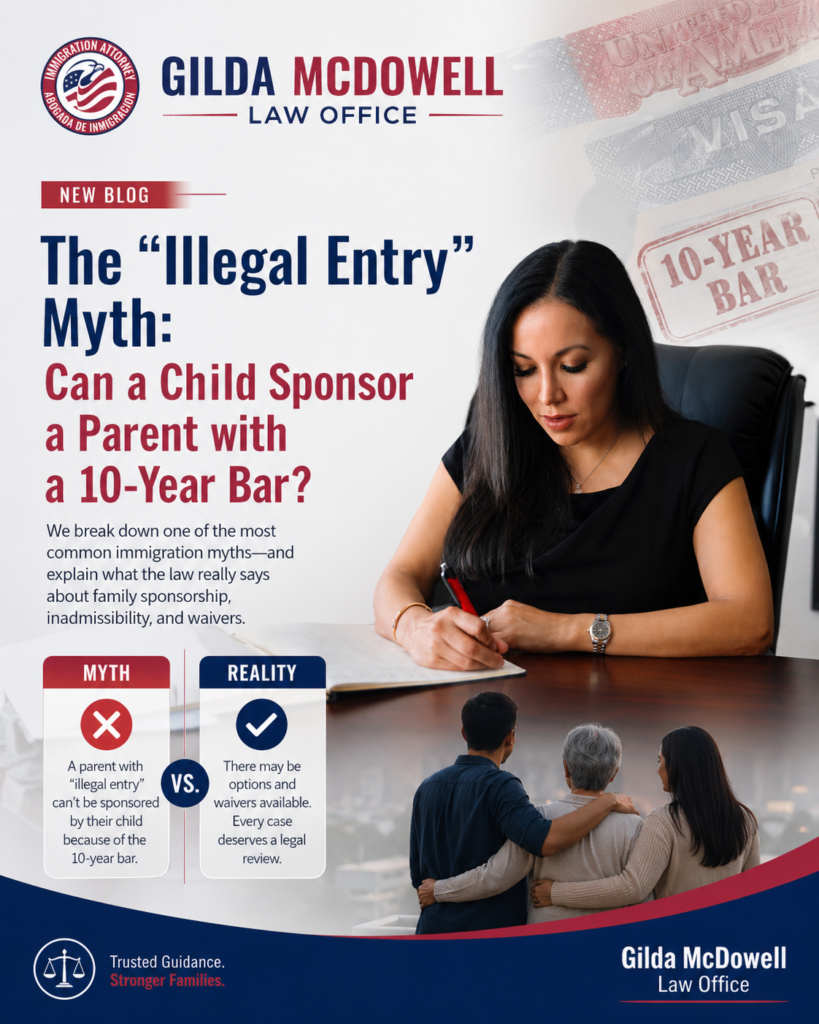
For many families living in the United States, the question “Can a U.S. citizen child sponsor a parent with a 10-year bar?” is not just a legal concern—it is a deeply personal fear tied to years of uncertainty, sacrifice, and silence.
Many parents who entered the country without inspection or overstayed a visa have spent decades building a life, raising children, and contributing quietly to their communities. Now, with their children finally grown and able to sponsor them, a new hope emerges—but so does a heavy emotional burden. Guilt over past “illegal entry,” fear of immigration consequences, and confusion about what filing actually triggers often stop families from taking the next step.Seldom discussed in basic explanations is this reality: sponsorship by a U.S. citizen child does not automatically fix immigration problems, nor does it instantly put a parent at risk in the way many communities fear. The real issue lies in how past immigration history interacts with specific legal bars and whether a lawful pathway can still be built.This is why timing, strategy, and accurate understanding matter right now—not later. One wrong assumption can delay family unity for years. One correct step, taken with clarity, can open a path forward that many families don’t even realize exists.
Diagnose the Core Problem
The real issue is not sponsorship it is fear-driven misunderstanding of immigration consequences
At the heart of the question “Can a U.S. citizen child sponsor a parent with a 10-year bar?” is a deeper problem that most families never fully recognize: they are not just dealing with immigration law—they are reacting to fear, guilt, and misinformation at the same time.
Many parents assume their past “illegal entry” automatically blocks any chance of legalization. Others believe that if their U.S. citizen child files a petition, it will immediately expose them to deportation. These beliefs feel logical in communities where information is passed informally, but they often misrepresent how the system actually works.
The result is a powerful blind spot: families delay action for years, not because they have no options, but because they assume they have none.
Why the 10-year bar is often misunderstood
A common misunderstanding is treating the 10-year bar as a permanent punishment rather than a conditional rule. In reality, it typically applies when someone leaves the U.S. after a certain period of unlawful presence.
This creates a critical misconception:
Many people think the bar is already “attached” to them simply because they are undocumented.But the real legal trigger is often departure, not just presence.This misunderstanding shapes the entire decision-making process—and often leads families to avoid seeking legal clarity altogether.
Expert insight: The hidden emotional driver that changes everything
The most overlooked factor is not legal—it is psychological. Many parents feel they must “protect” their U.S. citizen children by avoiding any legal process that might “bring attention” to the family. This protective instinct often overrides rational evaluation.
As a result, families do not ask the right question. Instead of asking what options exist, they assume taking action is dangerous by default.
This emotional bias becomes the true barrier—not the law itself.
Understanding this is the first step to correctly answering the keyword question: a child’s ability to sponsor a parent is not blocked by fear-based assumptions, but by specific legal conditions that must be clearly evaluated.
The core takeaway
The real problem is not whether sponsorship exists—it is whether families can separate emotional fear from actual legal risk long enough to understand their true position.
Reveal a Hidden Dynamic or Overlooked Factor
The hidden rule most families miss: approval is not protection
One of the most misunderstood dynamics behind the question “Can a U.S. citizen child sponsor a parent with a 10-year bar?” is this: even when a family petition is approved, it does not protect the parent from immigration consequences or automatically resolve unlawful presence issues.
This creates a false sense of safety. Many parents believe that once their U.S. citizen child files for them, their situation becomes “legal” in practice. In reality, immigration law operates in separate stages, and approval of a family relationship is only the first step—not the final decision on whether a person can stay or adjust status.
Timing is the silent factor that changes outcomes
The most overlooked factor is timing of travel and departure from the United States. For many families, the 10-year bar does not become relevant until a specific action is taken—leaving the country after accumulating unlawful presence.
This is where serious, often irreversible mistakes happen. Families may file petitions thinking they are “getting in line,” but later travel for emergencies, family visits, or misunderstandings—unknowingly triggering the bar.
The result is a legal situation that feels sudden, but is actually the consequence of timing decisions made without full information.
This is why the semantic question “U.S. citizen child sponsoring parent after unlawful entry” is often incomplete without considering departure rules and waiver eligibility.
Expert insight: Why “doing nothing” feels safer—but often isn’t
A major hidden dynamic is that in immigrant households, inaction often feels like protection. Many parents assume that avoiding the system keeps them safe. But in reality, it often limits future options because certain legal pathways depend on proper sequencing of filings and eligibility checks.
According to the U.S. Department of Homeland Security’s immigration overview, immigration outcomes depend heavily on admissibility factors assessed at different stages—not just relationship eligibility.
This means the system does not evaluate cases in one step—it evaluates them in layers. And missing one layer due to fear or misinformation can close options that might otherwise have been available.
The key takeaway
The hidden truth is simple but critical: sponsorship is not just about eligibility—it is about timing, sequence, and understanding how each legal stage interacts. Without that clarity, families may unintentionally put themselves at greater risk while trying to stay safe.
.
The Stakes and Consequences
When misunderstanding becomes a long-term family cost
For many families asking “Can a U.S. citizen child sponsor a parent with a 10-year bar?”, the biggest risk is not applying—it is misunderstanding the process and acting without full awareness of consequences. In immigrant households where decisions are often made quietly and under emotional pressure, even small mistakes can create years of separation or financial strain.
Legal consequences: losing options without realizing it
One of the most serious risks is unintentionally triggering the 10-year bar by leaving the U.S. at the wrong time. A parent may believe they are simply attending a family emergency abroad, only to later discover they are locked out of returning for a decade unless a waiver is approved.Another common issue is filing assumptions. Some families think a U.S. citizen child sponsoring a parent automatically secures legal protection. It does not. Without understanding admissibility rules, families may create incomplete strategies that limit future pathways.
Financial consequences: wasted time, repeated filings, and instability
For lower-to-middle income families, even modest legal filing fees, translation costs, and travel expenses can add up. More damaging, however, is the loss of time—years spent waiting under a false assumption that progress is being made.
In many cases, families delay consulting professionals, believing the process is simple. Later, they may need to restart filings, address avoidable complications, or fix preventable mistakes—all of which increase financial stress.
Emotional consequences: fear becomes a permanent state
Emotionally, the impact is often heavier than the legal side. Parents may live with ongoing anxiety about being “discovered” or separated from their children. Adult U.S. citizen children may feel pressure to fix their parents’ situation but become overwhelmed when unexpected legal barriers appear.
This emotional strain is especially intense in multi-generational homes, where the issue is present every day but rarely discussed openly.
Long-term consequences: delayed security and lost years together
The most overlooked cost is time itself. Every year spent in confusion or hesitation is a year of missed stability—missed travel freedom, missed peace of mind, and missed opportunity to secure lawful status earlier.
In the context of “U.S. citizen child sponsoring parent after unlawful entry,” delay often does not preserve safety—it postpones resolution.
A Framework or Guidance Path
A simple decision framework for understanding your real position
When families ask “Can a U.S. citizen child sponsor a parent with a 10-year bar?”, the confusion usually comes from not knowing what step to take first—or what information actually matters. This framework helps turn uncertainty into a clear decision path.
Step 1: Confirm the family relationship (eligibility foundation)
Start with the basic requirement:
- The child must be a U.S. citizen (21+)
- The parent-child relationship must be clearly proven
Why it matters:
This step only confirms eligibility for sponsorship—it does not determine immigration safety or approval.
What to avoid:
Do not assume eligibility means legal status is already possible.
Step 2: Identify immigration history honestly
Ask three key questions:
- Did the parent enter without inspection?
- Has there been unlawful presence?
- Has the parent ever left the U.S. after that unlawful stay?
- Why it matters:
These answers determine whether the 10-year unlawful presence bar may apply.
Step 3: Understand the separation between filing and approval
Filing a petition (I-130) and getting a green card are not the same process.
Why it matters:
A common mistake is assuming sponsorship automatically resolves status. It does not.
Step 4: Evaluate risk before any travel decisions
Before leaving the U.S., families must understand:
- Whether departure could trigger the 10-year bar
- Whether a waiver may be required
- Whether staying inside the U.S. changes eligibility options
What to avoid:
Never make travel decisions based on urgency alone (family emergencies, visits, or assumptions).
Step 5: Identify whether a waiver pathway may exist
If the 10-year bar applies, some cases may still qualify for a waiver based on hardship to a U.S. citizen child.
Why it matters:
This is often the only structured legal path forward in complex cases.
Core takeaway
The safest way to approach “U.S. citizen child sponsoring parent after unlawful entry” is not speed—it is structured evaluation. Each step builds clarity and prevents irreversible mistakes.
What a Strong Outcome Looks Like
What success actually looks like for families in this situation
For parents asking “Can a U.S. citizen child sponsor a parent with a 10-year bar?”, a strong outcome is not just approval on paper—it is stability, clarity, and the ability to live without constant fear of separation or uncertainty.
In the best-case scenario, the family moves through the process with a full understanding of the rules before taking action. They know whether the 10-year unlawful presence bar applies, whether travel is safe, and whether a waiver strategy is needed. Instead of reacting to fear, they follow a structured plan that protects the parent’s ability to stay connected to their U.S. citizen child.
Strong outcome vs. weak outcome
A strong outcome typically looks like this:
- The family avoids triggering the 10-year bar unintentionally
- The petition process is handled with full awareness of risks
- A waiver or legal pathway is identified early if needed
- The parent gains long-term stability and reduced fear of sudden immigration consequences
- The family can plan life decisions—work, travel, and caregiving—without constant uncertainty
A weak outcome, on the other hand, often looks like:
- Acting without understanding inadmissibility risks
- Triggering the 10-year bar through unplanned travel
- Spending years in confusion or repeated filings
- Living with ongoing fear of enforcement or separation
- Delayed or permanently lost opportunities for lawful adjustment
Why preparation changes everything
The difference between these outcomes is not luck—it is timing and preparation. Families who take time to understand how U.S. citizen child sponsoring parent after unlawful entry cases actually work are able to make decisions with clarity instead of urgency.
Proper preparation reduces emotional pressure on both parents and adult children. It also creates financial predictability by avoiding unnecessary filings or repeated attempts that do not address the real issue.
Future state: the life families are really seeking
In the ideal outcome, parents are no longer living with daily anxiety about status. They are not avoiding travel out of fear or worrying about unexpected consequences. Instead, they have a clear understanding of their position and a realistic plan toward long-term security.
For many families, that means peace of mind finally replaces uncertainty—and decisions are made with confidence, not fear.
FAQs
1. Can a U.S. citizen child sponsor a parent with a 10-year bar if they entered illegally?
Yes, a U.S. citizen child can file a petition for a parent, but it does not automatically remove the 10-year bar or fix prior immigration violations. The real issue is whether the parent is considered “inadmissible” under immigration rules. In many cases, additional steps like waivers may be required. The sponsorship is only the starting point, not the final solution.
2. Can a U.S. citizen child sponsor a parent after unlawful entry without triggering immigration problems?
Filing a petition itself usually does not trigger enforcement action, but the parent’s history still matters. The key risk comes from misunderstanding how unlawful presence and departure rules work together. Many families assume filing is dangerous, when the real risk often comes from travel decisions made without guidance. Careful planning reduces exposure significantly.
3. What happens if my parent has already triggered the 10-year bar—can sponsorship still help?
Yes, sponsorship may still be part of the process, but it is not enough on its own. The 10-year bar creates a serious obstacle that may require a waiver or other legal strategy. The child’s petition is still important because it establishes the family relationship. However, it must be paired with a clear plan for overcoming inadmissibility.
4. What is the biggest mistake families make when asking about a 10-year bar and sponsorship?
The most common mistake is assuming that sponsorship automatically leads to legal status. Another major mistake is waiting too long because of fear or misinformation. This delay can reduce available options over time. Understanding the process early helps prevent avoidable complications.
5. Can a U.S. citizen child sponsor a parent if they are currently undocumented in the U.S.?
Yes, a child can still file a petition even if the parent is undocumented. However, the outcome depends on the parent’s immigration history, including unlawful presence and prior entries. Being undocumented does not automatically disqualify someone, but it does require careful legal evaluation. Each case must be reviewed individually.
6. Does filing for a parent increase the risk of deportation?
In most cases, filing a petition does not directly increase enforcement risk. However, immigration history still matters, and mistakes in timing or travel can create problems. Many fears come from misinformation rather than actual legal consequences. Understanding the process reduces unnecessary fear and confusion.
7. How does the 10-year bar affect families asking about parent sponsorship?
The 10-year bar can prevent a parent from returning to the U.S. if they leave after unlawful presence. This is where many families get confused when considering sponsorship. The child’s petition alone does not remove this bar. Strategic planning is required to avoid triggering it unintentionally.
8. What should families avoid when trying to fix a parent’s immigration status?
Families should avoid making travel decisions without understanding the consequences. They should also avoid relying on informal advice from friends or community rumors. Another major risk is assuming that waiting longer improves the situation. In reality, delay can sometimes limit future options.
9. Is it better to wait or act quickly when dealing with sponsorship and a 10-year bar?
Neither extreme is ideal. Acting too quickly without understanding risks can lead to serious consequences, while waiting too long can reduce available legal pathways. The best approach is structured evaluation before any action. Clarity is more important than speed.
10. What is the safest first step for families asking about U.S. citizen child sponsorship and the 10-year bar?
The safest first step is understanding the parent’s full immigration history before filing anything. This includes entry method, time spent unlawfully in the U.S., and any prior departures. Once these facts are clear, families can better understand what risks exist. This prevents avoidable mistakes and creates a more stable path forward.
Conclusion
The question “Can a U.S. citizen child sponsor a parent with a 10-year bar?” reflects more than just a legal concern it reflects years of uncertainty, fear, and hope within families trying to stay together in the United States. As this article has shown, sponsorship alone does not determine the outcome. The real outcome depends on understanding how unlawful presence, timing, and inadmissibility rules interact.
Many families stay stuck because they rely on assumptions: that filing is dangerous, that the past cannot be fixed, or that waiting will make things safer. In reality, uncertainty is often more damaging than the law itself. It leads to delayed decisions, missed opportunities, and unnecessary emotional strain.
On the other hand, families who take time to understand the structure of the process gain something powerful—clarity. They can see risks before they happen, avoid decisions that trigger long-term consequences, and identify whether a lawful pathway may still exist.
The difference between staying in confusion and moving forward is not just information—it is timing and informed action.
If you are trying to understand how the U.S. citizen child sponsoring parent after unlawful entry process applies to your situation, the safest step is to get clear answers before making any decisions that could affect your family’s future.
If you are unsure where your case stands or worried about potential risks like the 10-year bar, you can reach out for a confidential conversation. Getting clarity early can help you avoid irreversible mistakes and make informed, careful decisions that protect your family’s future.