
Introduction
For many skilled trade workers, the journey from a seasonal job to a stable future in the United States is filled with uncertainty. If you are working under an H-2B visa, you already know the reality: your ability to stay depends on your employer, your job timing, and immigration rules that often feel unclear until it is almost too late.
This is exactly where H-2B to Permanent Resident: The Step-by-Step Path becomes critical. It is not just an immigration process—it is a timing-sensitive transition that can determine whether you build a long-term life in the U.S. or remain stuck in repeating seasonal cycles year after year.
What most workers are never clearly told is this: having a steady job does not automatically move you toward a Green Card. The process depends heavily on employer commitment, early legal planning, and understanding steps like PERM labor certification long before paperwork actually begins.
For skilled mechanics, landscapers, and ag-tech workers, the biggest pressure is not just working hard—it is the fear that everything could stop if the employer delays, changes direction, or cannot continue sponsorship.
This guide breaks down the process in simple, practical terms so you can understand what is happening behind the scenes—and what needs to happen next before time becomes your biggest risk.
The Core Problem
The real issue is not paperwork — it is control
Most skilled trade workers believe the biggest challenge in the H-2B to Permanent Resident: The Step-by-Step Path is filing documents correctly or meeting eligibility rules. In reality, the deeper problem is control over timing and sponsorship decisions.
In this system, the worker does not control the process. The employer does.
That single fact changes everything.
Many H-2B workers assume, “I have a stable job, so my Green Card process is already in motion.” But stability in employment is not the same as progress in immigration. Without formal employer action toward PERM labor certification, nothing legally moves forward.
The blind spot: confusing job security with immigration security
Skilled mechanics, landscapers, and ag-tech workers often misread their situation. Because they are valued at work, they assume sponsorship is guaranteed or “will happen soon.”
But immigration law does not work on trust or loyalty—it works on formal filings, strict timelines, and employer commitment.
This creates a dangerous blind spot:
- You may feel secure in your job
- While legally, no permanent residency process has even started
This gap between perception and reality is where most delays and missed opportunities happen.
Expert insight: the silent delay problem most workers never see
One of the most overlooked dynamics in the H-2B visa permanent residency path is silent delay.
Employers often intend to sponsor but postpone action due to:
- workload
- cost concerns
- uncertainty about long-term staffing needs
- lack of urgency until a visa deadline approaches
From the worker’s perspective, everything feels “in progress.”
From the legal perspective, nothing has started.
This mismatch is the single most common reason skilled workers lose years in temporary visa cycles.
Why this problem creates pressure and fear
For employer-sponsored skilled workers, the emotional burden is real:
- fear of losing the job before sponsorship begins
- uncertainty about whether the employer will commit
- frustration at not knowing when to push or stay quiet
This is not just an immigration issue—it is a timing and communication problem disguised as paperwork.
Understanding this core disconnect is the first step to taking real
Hidden Dynamic or Overlooked Factor
The timing rules behind PERM are stricter than most workers realize
A major hidden reality in the H-2B to Permanent Resident: The Step-by-Step Path is that the process is not just slow—it is time-restricted at multiple legal stages. Even when an employer is willing to sponsor, the system does not allow unlimited flexibility.
One of the most critical but least discussed rules is that PERM labor certification depends on a tightly controlled recruitment window. Employers must complete specific hiring steps within fixed time limits before they can even file the application. If that window expires, the entire process must be restarted.
This is where many skilled workers misunderstand their situation. They assume “waiting” is harmless. In reality, waiting can reset progress to zero.
The overlooked risk: recruitment expiration and employer delays
In the H-2B visa permanent residency path, employers must go through labor market testing—advertising the job and proving no qualified U.S. worker is available. However, those recruitment steps are only valid for a limited period before PERM filing.
If the filing is delayed too long:
- recruitment results expire
- the employer must repeat the process
- months of progress are lost
This creates a silent but serious risk for workers whose employers are busy, understaffed, or unsure about long-term sponsorship commitment.
For skilled trade workers relying on job stability, this is especially dangerous because seasonal or project-based companies may delay decisions until workload stabilizes—often too late in the legal timeline.
Expert insight: employer intention is not the same as legal progress
A key misconception is assuming that once an employer says “we will sponsor you,” the immigration process is effectively underway. Legally, intention has no value until formal recruitment and filing steps are completed.
This gap is why many workers in landscaping, mechanics, and ag-tech roles lose valuable time without realizing it.
Why this matters right now
The U.S. Department of State emphasizes that employment-based immigration processes are sequence-driven and deadline-sensitive, meaning delays in early stages directly affect eligibility later.
Source:
For workers balancing seasonal contracts and uncertain employer timelines, this creates a fragile situation: even small delays in employer action can determine whether the H-2B to permanent resident transition succeeds or resets entirely.
Understanding this timing structure is essential—because in this process, lost time is rarely recoverable.
The Stakes and Consequences
When timing fails, the entire immigration path collapses
For many skilled trade workers, the H-2B to Permanent Resident: The Step-by-Step Path feels like something that will “eventually work itself out.” But the reality is far more fragile. If the process is delayed, misunderstood, or not actively managed, the consequences are not gradual—they are sudden and disruptive.
This is not just about missing paperwork. It is about losing years of progress in one decision cycle.
Financial consequences: instability that compounds over time
Workers in H-2B roles often earn steady but limited income, usually in the $50k–$75k range. When the permanent residency process is delayed:
- income remains capped by seasonal structures
- career advancement stalls because mobility is restricted
- long-term financial planning (home, savings, family investment) becomes uncertain
A landscaper or mechanic who assumes sponsorship is “in progress” may stay in the same cycle for 3–5 years without realizing they are not moving forward legally.
Legal consequences: losing eligibility without warning
In the H-2B visa permanent residency path, timing is everything. If the employer delays PERM filing or fails to maintain compliance:
- the process can reset completely
- visa status may expire without transition readiness
- workers may need to leave or restart under a new employer
Even loyal employees can lose eligibility simply because procedural steps were not completed on time.
Emotional consequences: pressure without clarity
The emotional burden is often underestimated. Many workers experience:
- constant uncertainty about “what stage am I at?”
- fear of asking employers the wrong questions
- stress from not knowing whether their future is secured or temporary
For someone supporting a family, this uncertainty becomes a daily mental load—especially when coworkers or friends appear to be moving forward while they remain stuck.
Long-term consequences: missed life trajectory
The biggest loss is not immediate—it is what never gets built:
- delayed permanent residency
- postponed family stability
- missed opportunities for promotions or long-term contracts
- continued dependence on seasonal work cycles
Over time, the difference between acting early and waiting silently becomes the difference between stability and repeated uncertainty.
Understanding these stakes is essential because in this system, delay is not neutral—it actively reshapes your future.
A Framework or Guidance Path
The “5-Stage Control Framework” for H-2B to Green Card Progress
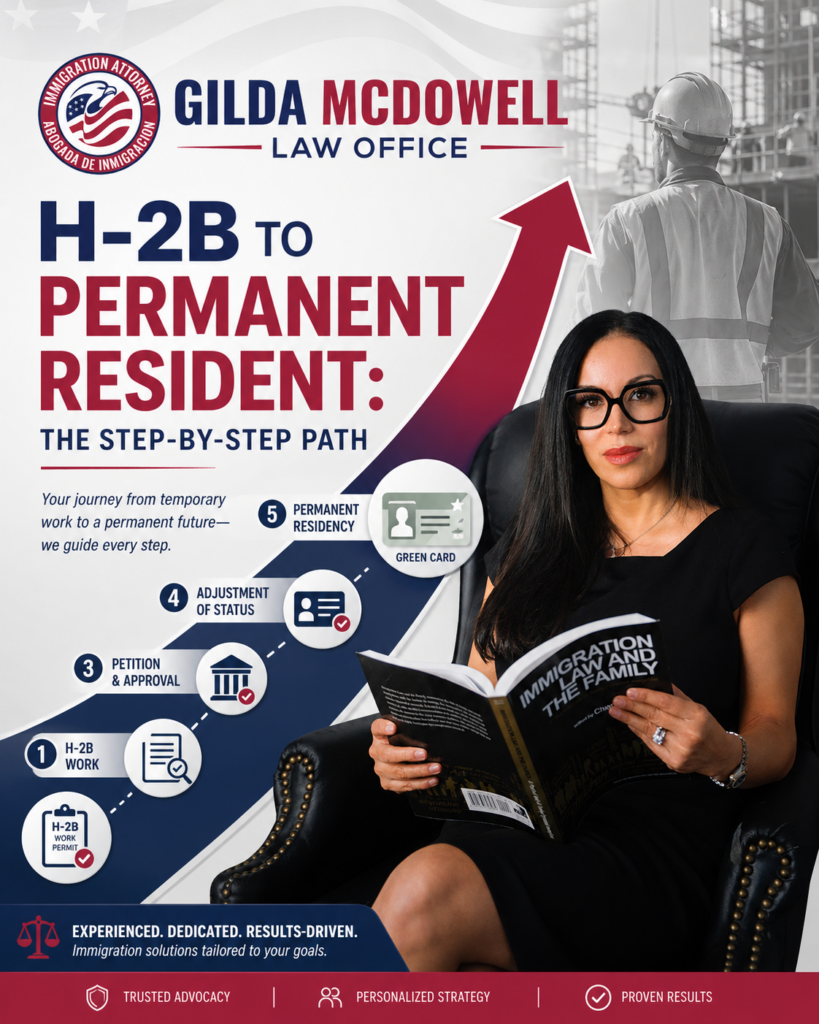
For skilled trade workers navigating the H-2B to Permanent Resident: The Step-by-Step Path, clarity comes from structure—not guesswork. The following framework helps you understand exactly where you are, what should happen next, and where risks usually appear.
This is designed for workers who want efficiency, direct answers, and predictable steps.
Stage 1: Employer Commitment Check (Before Anything Starts)
What to do:
Confirm—clearly and directly—whether your employer is willing to begin sponsorship.
Why it matters:
Without formal commitment, nothing in the immigration process can legally begin.
What to avoid:
Do not assume verbal promises mean active processing.
Stage 2: Role Eligibility Review
What to do:
The job must be evaluated to see if it qualifies for PERM labor certification under the H-2B visa permanent residency path.
Why it matters:
Not all roles qualify, even if the worker is highly skilled.
What to avoid:
Avoid delaying this step; uncertainty here often creates months of wasted time.
Stage 3: Recruitment Compliance Phase
What to do:
Employer conducts required job advertisements and labor market testing.
Why it matters:
This step proves no qualified U.S. worker is available.
What to avoid:
Do not assume this step is optional—it is mandatory and time-sensitive.
Stage 4: PERM Filing Window
What to do:
File the PERM application within the valid recruitment period.
Why it matters:
If the filing window expires, the process must restart from recruitment.
What to avoid:
Avoid employer delays that push filings outside the legal timeframe.
Stage 5: Immigrant Petition Stage (I-140)
What to do:
After PERM approval, the employer files the immigrant petition to move toward permanent residency.
Why it matters:
This is the transition from labor certification to Green Card progression.
Core Decision Rule for Workers
If you cannot identify which stage you are in right now, you are already exposed to risk.
The key is not just progress—it is visibility. Workers who understand their stage early reduce delays, prevent expired recruitment cycles, and avoid restarting the H-2B to green card process unnecessarily.
Authoritative Reference
U.S. Citizenship and Immigration Services explains the employment-based permanent worker process structure
Final Insight
Control comes from tracking stages, not waiting for outcomes. If any stage is unclear or delayed, the risk increases immediately—regardless of job stability.
A Strong Outcome Looks Like
What success actually looks like in the H-2B to Green Card journey
A strong outcome in the H-2B to Permanent Resident: The Step-by-Step Path is not just “getting approved.” It is having a system in motion where every stage is planned, timed correctly, and protected from unnecessary delays.
For skilled trade workers, this changes everything.
Instead of wondering whether sponsorship will happen, you know exactly where your case stands, what is already completed, and what is coming next. Your future is no longer based on assumptions—it is based on documented progress.
Strong outcome: stability, clarity, and forward planning
When the H-2B visa to permanent residency process is handled correctly and early:
- Financial stability improves
You are no longer locked into seasonal uncertainty. You can plan savings, long-term investments, and family expenses with confidence. - Time is no longer wasted
You avoid restarting recruitment cycles or losing eligibility due to expired timelines. - Emotional pressure reduces significantly
Instead of constant fear about “what if my employer stops sponsoring,” you operate with clarity and structured expectations. - Control increases for both worker and employer
Communication becomes straightforward: clear stages, clear deadlines, clear responsibility.
Weak outcome: uncertainty and repeated cycles
Without structure or timing awareness:
- Workers remain in temporary visa loops for years
- Employers unintentionally delay PERM steps
- Recruitment windows expire, forcing restarts
- Emotional stress builds due to lack of visibility
- Long-term goals like residency, family stability, and career growth remain out of reach
The difference is not effort—it is timing and process awareness.
The future state skilled workers are actually aiming for
The ideal outcome is simple but powerful:
- Permanent residency secured through a properly executed H-2B to green card process
- Predictable employment without seasonal interruptions
- Confidence in long-term stay and financial planning
- Reduced dependency on visa renewal cycles or employer uncertainty
When done correctly, the process becomes structured rather than stressful.
Authoritative Reference
The U.S. Department of Labor outlines employer responsibilities and structured requirements for employment-based certification programs, reinforcing the importance of compliance and timing:
Final Insight
The strongest outcomes are not accidental. They come from early action, clear stage awareness, and avoiding delay cycles that silently reset progress.
7. FAQs — H-2B to Permanent Resident: The Step-by-Step Path
1. What is the H-2B to Permanent Resident: The Step-by-Step Path?
It is the process of moving from a temporary seasonal H-2B visa to a Green Card through employer sponsorship. This usually involves PERM labor certification and several structured legal steps. The process is not automatic and depends heavily on employer action and timing. Many workers misunderstand it as a simple upgrade, but it is actually a multi-stage system that must be actively managed.
2. How long does the H-2B to green card process usually take?
The H-2B visa to permanent residency process can take several years depending on employer readiness and government processing times. Delays often occur during recruitment or filing stages. If steps are not initiated early, timelines can extend significantly. Workers should understand that timing is just as important as eligibility.
3. Can I move from H-2B to permanent resident without my employer?
No, you cannot complete the process alone. The H-2B to Permanent Resident: The Step-by-Step Path requires employer sponsorship because PERM labor certification is employer-driven. This means your job role, employer commitment, and legal filings are all connected. Without employer participation, the process cannot move forward.
4. What is the biggest mistake workers make in the H-2B to green card process?
The most common mistake is assuming that verbal promises from an employer mean the process has started. Many workers wait months or years without confirming whether PERM filing has actually begun. This delay can cause recruitment windows to expire, forcing the process to restart. Early clarity is essential.
5. What happens if my employer delays the PERM process?
Delays can cause recruitment results to expire, meaning the employer must restart the process from the beginning. This is one of the most common risks in the H-2B visa permanent residency path. Workers often lose valuable time without realizing anything has technically stalled. Delay does not pause the system—it resets parts of it.
6. Can I stay in the U.S. while my Green Card process is pending?
Yes, but only if your visa status remains valid throughout the process. The H-2B to Permanent Resident: The Step-by-Step Path does not automatically protect your stay. Maintaining legal status is separate from immigration progress. Losing status can interrupt or end your application process.
7. What jobs qualify for PERM labor certification?
Not all jobs qualify. The role must generally require specific skills and meet U.S. labor certification standards. Skilled trades like mechanics, specialized landscaping, and ag-tech roles may qualify depending on employer requirements. Each case depends on job duties, not just job titles.
8. Why does timing matter so much in the H-2B to green card process?
Timing determines whether recruitment results are still valid when filing occurs. If deadlines are missed, employers must restart key steps, which delays the entire H-2B visa to permanent residency process. Even small delays can create long-term setbacks. This is why early action is critical.
9. Can switching employers affect my H-2B to permanent resident application?
Yes, switching employers can reset or complicate the process depending on the stage of PERM filing. Because the system is employer-specific, a change often means starting over. Workers should understand the stage they are in before making any job move decisions.
10. What is the safest strategy to avoid delays in the H-2B to green card process?
The safest approach is early confirmation of employer sponsorship and clear tracking of each stage of the process. Workers should avoid assuming progress without documentation. Understanding the H-2B to Permanent Resident: The Step-by-Step Path helps prevent silent delays that can reset months of progress. Clarity and timing are the strongest protections.
Conclusion
The journey from temporary work to permanent residency is not defined by effort alone—it is defined by timing, clarity, and employer action. As this guide has shown, the H-2B to Permanent Resident: The Step-by-Step Path is often misunderstood as a simple progression, when in reality it depends on strict stages, hidden deadlines, and employer-driven decisions.
The biggest risk for skilled trade workers is not rejection—it is silent delay. When recruitment steps expire, when employer action slows, or when assumptions replace confirmed filings, progress can reset without warning. This creates years of uncertainty that many workers only recognize after opportunities have already been lost.
In contrast, those who understand the structure early gain control. They move with awareness, track each stage, and reduce avoidable delays that keep others stuck in seasonal cycles. The difference is clear: one path leads to repeated uncertainty, while the other leads to stability, long-term planning, and legal clarity.
For employer-sponsored skilled workers, acting early is not about urgency—it is about protection. Understanding where you stand today can determine what your future looks like tomorrow.
If you are unsure whether your process has actually started or whether your employer is on track with your H-2B visa to permanent residency process, a confidential conversation can help you understand your position clearly and avoid preventable delays. Taking that step now can bring the clarity needed to make informed, confident decisions about your future.